
While fitting a linear regression model to estimate home sale prices from property attributes, which assumption about how predictors relate to the target is fundamental to the model form?
Select an answer to reveal the explanation.
Short Explanation and Infographic
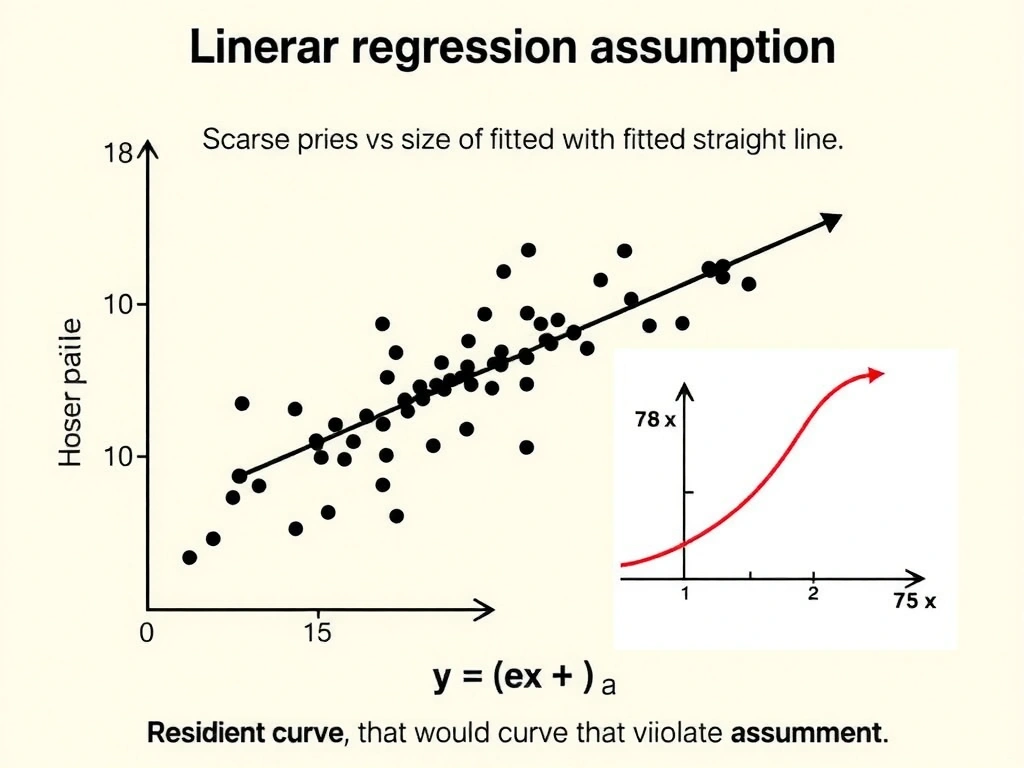
Here's the deal with linear regression: it's in the name. You're assuming price is basically a weighted sum of your features—plus some noise. Square footage up, predicted price up by a fixed amount per square foot, all else equal. Think of it like a recipe with fixed spoonfuls of each ingredient. If the real world is a crazy nonlinear mess, plain linear regression will underfit unless you engineer features. Exam trap: confusing "features should be independent" with the core linearity assumption. Independence isn't required for the model definition. Land the takeaway: linear relationship between inputs (as used) and the output is the foundation.
Full explanation below image
Full Explanation
Ordinary linear regression models the conditional expectation of a continuous target as a linear function of parameters: the response equals an intercept plus weighted features plus an error term, or a linear function of transformed features if you expand the basis yourself. That structural assumption is what makes closed-form ordinary least squares and many diagnostic tools applicable. If the true relationship is strongly curved or interactive and you do not add appropriate transforms or interaction terms, residual plots will show structure and predictions will be biased in regions of the feature space. Housing prices often need log transforms or nonlinear terms for size and location effects, which is why practitioners check residuals instead of trusting the functional form blindly.
Related classical assumptions for inference—such as errors with constant variance, uncorrelated residuals, and approximate normality—support confidence intervals and hypothesis tests, but the defining modeling claim of linear regression remains the linear link between the possibly engineered features and the mean response. Features need not all be categorical; continuous predictors are standard. Predictors need not be mutually independent: correlated inputs can still yield a valid predictive model, though coefficients become harder to interpret and more unstable under multicollinearity. Independence of features is therefore a diagnostic concern, not the core definition of the model class.
The distractor that requires categorical inputs confuses encoding practice with model assumptions. The distractor that requires feature independence elevates a multicollinearity concern into a false necessity. The distractor that asserts a nonlinear complex relationship describes situations where linear regression is misspecified unless features are transformed to restore approximate linearity in the parameters.
In applied work, validate linearity with residual-versus-fitted plots, partial residual plots, and domain knowledge from appraisers or market analysts. When linearity fails, use polynomial or spline terms, generalized additive models, tree-based methods, or other nonlinear learners. For the exam, when asked for the fundamental assumption of linear regression regarding features and target, choose the linear relationship statement and do not confuse it with requirements about feature types or pairwise independence.