
Within a reinforcement learning setup, what is meant by the state?
Select an answer to reveal the explanation.
Short Explanation and Infographic
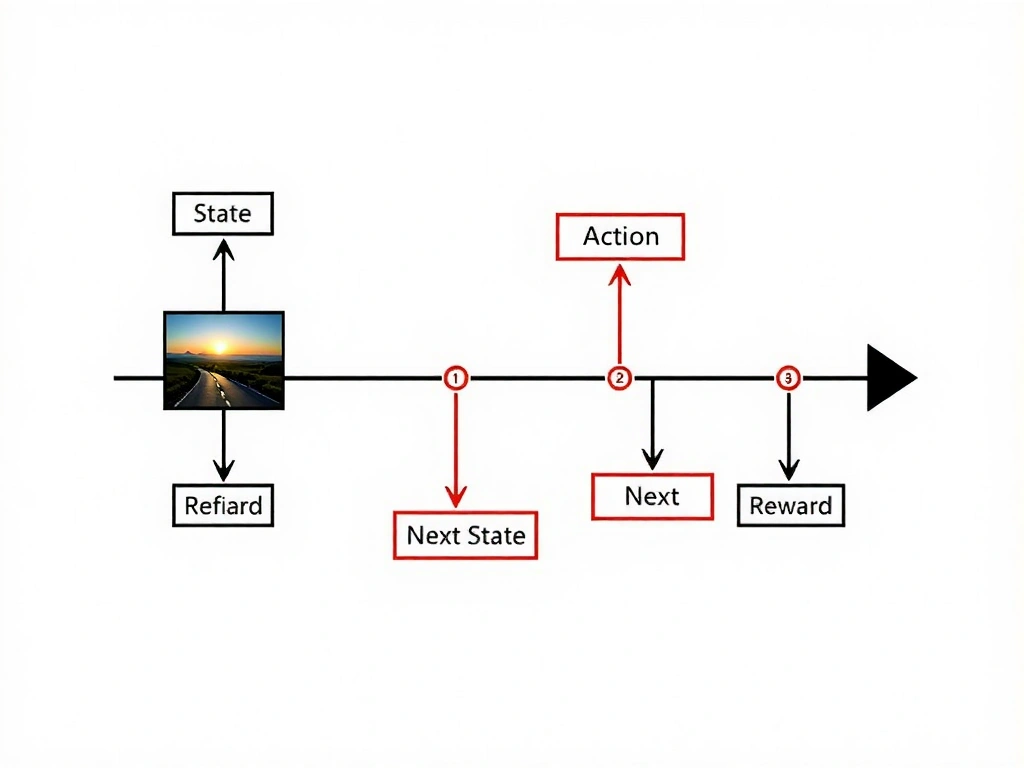
Let's keep the RL cast straight. State is "where things stand right now"—board position, robot joint angles, inventory levels, whatever the agent needs to decide. Reward is the score ping. Action is the move. Environment is the whole game world. Exam trap: calling the environment the state. Nope. The environment is the arena; the state is the snapshot on the scoreboard before your turn. If your boss asks why the agent chose poorly, you look at the state it saw and the policy it applied. Solid takeaway: state = current situation used for the decision. Everything else hangs off that.
Full explanation below image
Full Explanation
In the Markov decision process framework used by reinforcement learning, time unfolds in discrete steps. At each step the agent receives a representation of the situation, conventionally called the state (or an observation in partially observable settings). The state is intended to capture the information needed to choose an action and, under the Markov assumption, to make future evolution independent of the full history given the current state and action. Good state design is therefore central: if critical information is missing from the state, the agent cannot distinguish situations that require different actions, and learning becomes harder or impossible.
After the agent acts, the environment emits a reward and transitions to the next state. Thus state, action, reward, and environment play different roles: state describes conditions; action is the decision; reward is evaluative feedback; the environment defines transition and reward rules outside the agent's direct control. Policies map states to actions; value functions score states or state-action pairs under a policy. A trajectory is simply a sequence of states, actions, and rewards generated by this interaction loop over time.
Misconceptions arise when terms blur. Treating reward as state confuses feedback with situation description. Treating the entire environment as the state ignores that state is a time-indexed configuration, not the whole dynamical system. Treating actions as states confuses controls with the conditions that prompted them. In deep reinforcement learning, the state may be a learned representation from raw pixels or sensor streams, but conceptually it still plays the same role: the input to the decision rule at that moment. Engineers may stack frames, include velocities, or add memory modules so the effective state is closer to Markov.
For exam answers, prefer wording like current situation or configuration of the environment, or agent-relevant snapshot. That definition anchors every other reinforcement learning concept—trajectories, returns, exploration, and learning updates—without mixing labels. When a question asks what the state is, look for the snapshot-of-the-world idea, not the score, not the move, and not the entire simulation engine.