
In reinforcement learning, what does the policy represent?
Select an answer to reveal the explanation.
Short Explanation and Infographic
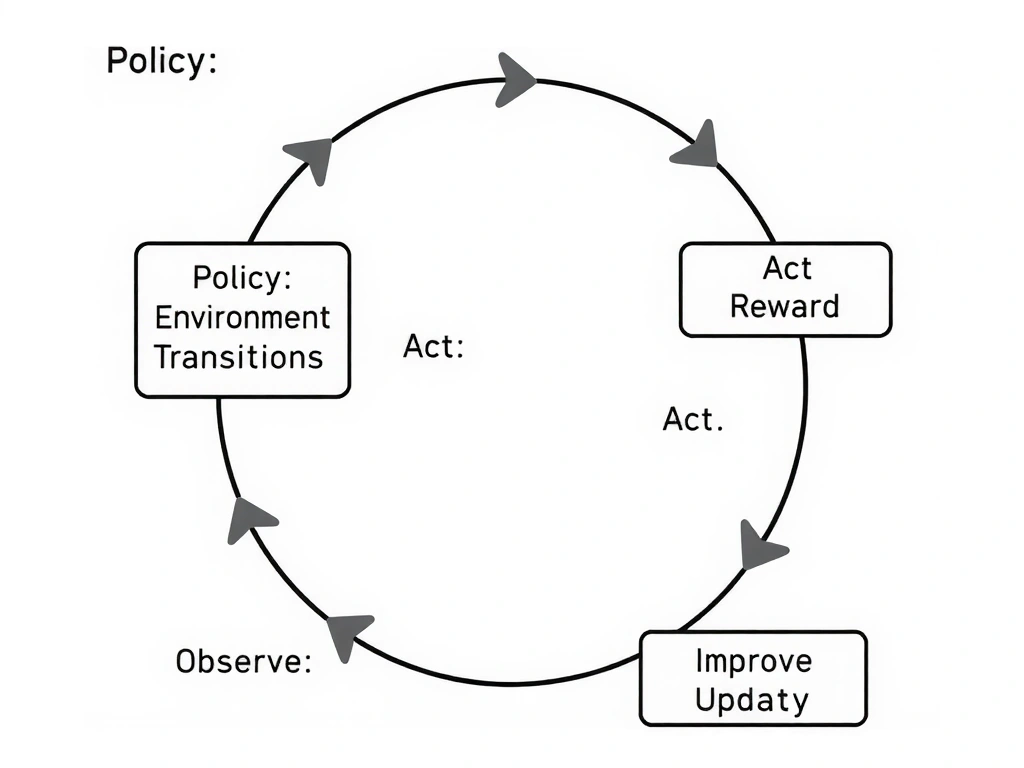
Here's the deal with RL jargon: the policy is the agent's playbook. State comes in, action goes out. Think of it like a GPS routing rule—given where you are, what turn do you take? The environment is the city and traffic. The reward is the score. The learning algorithm is how you rewrite the playbook after games. People mix these up constantly on exams. If the question says policy, look for "maps states to actions." Not the total reward, not the world, not the optimizer. Once that clicks, actor-critic, Q-learning, and policy gradients all make more sense. Got it? Keep rolling—policy first, then how we improve it.
Full explanation below image
Full Explanation
Reinforcement learning formalizes sequential decision-making. An agent interacts with an environment by observing a state (or observation), selecting an action, receiving a reward, and transitioning to a new state. The policy is the agent's strategy: a function that maps states to actions, either deterministically (a equals pi of s) or stochastically (a sampled from pi of a given s). Everything the agent decides is expressed through its policy, whether implemented as a lookup table, linear model, or deep neural network. In control terms, the policy is the closed-loop decision rule that turns situational information into controls at every time step of an episode.
Related but distinct objects include the environment's transition dynamics, the reward function, the return as cumulative discounted reward, and value functions that evaluate how good states or actions are under a policy. Learning algorithms—temporal-difference updates, policy gradients, actor-critic methods—adjust parameters so the policy improves expected return. Those algorithms are training procedures, not the policy definition. Likewise, a replay buffer stores experience, and a target network stabilizes learning; neither is the policy, though both may support learning a better one.
Common exam traps swap terminology. Calling the environment the policy confuses the world with the agent's control rule. Calling the optimizer the policy confuses the learning method with the decision mapping. Calling cumulative reward the policy confuses the objective with the behavior that generates it. Value functions estimate expected return under a policy; they support learning but still are not the policy unless used greedily to induce one, as in many Q-learning deployments where an epsilon-greedy rule over Q-values defines the behavioral policy.
Practically, when you read code or a paper, identify the module that, given the current state embedding, outputs action logits or continuous controls—that module is the policy (or actor). Evaluation asks how much return that policy earns; improvement asks how to change it. Remember the compact definition: policy equals state-to-action mapping. Once that is solid, you can reason about exploration with stochastic policies, on-policy versus off-policy learning, and policy evaluation versus policy improvement without mixing the pieces of the Markov decision process.