
Which statement best distinguishes bias from variance when diagnosing machine learning model error?
Select an answer to reveal the explanation.
Short Explanation and Infographic
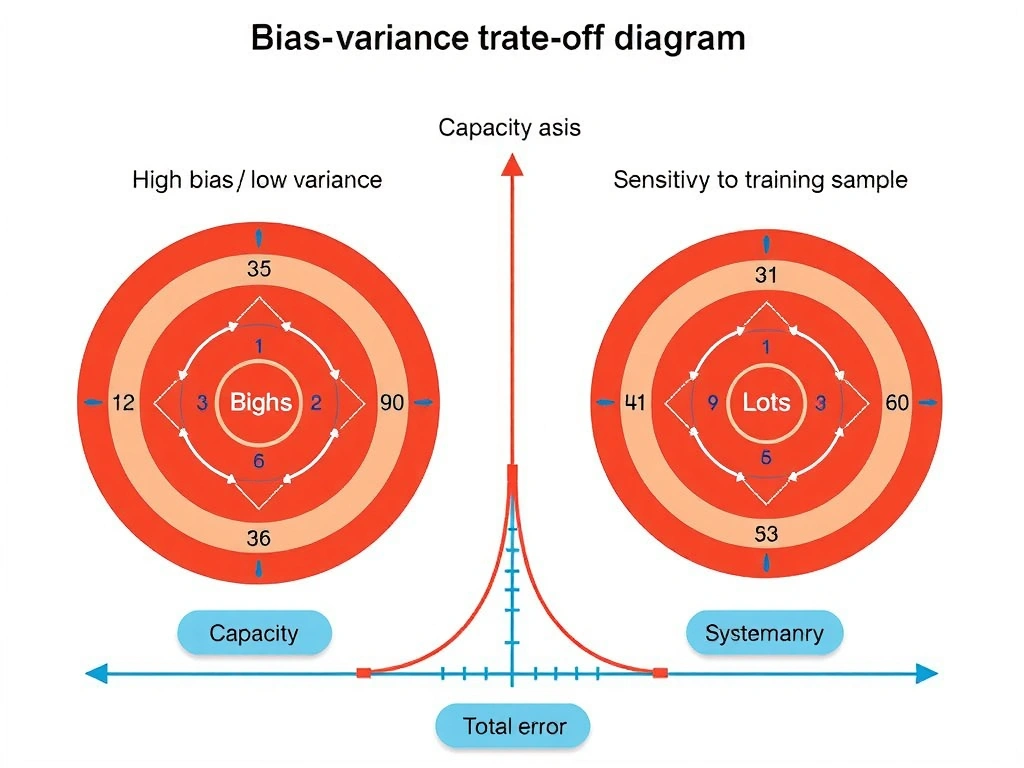
Check this out—bias and variance aren't stopwatch stats, and they're not "one model vs many models." Bias is when your model keeps making the same kind of wrong call because it's too rigid or misspecified. Variance is when a tiny data shuffle rewires the answer. Think of a GPS that always thinks you're two blocks north—that's bias. A GPS that jumps all over town every time you recalibrate—that's variance. Exam trap: equating bias only with "simple" and variance only with "complex" without talking about error. Simpler models often raise bias; flexible ones often raise variance—but the definitions live in the error behavior. Nail that, and the trade-off questions get easy.
Full explanation below image
Full Explanation
The bias-variance framework explains how expected prediction error arises from three sources: systematic discrepancy between the average model and the true function (bias), variability of the fitted model across training samples (variance), and irreducible noise. Bias rises when the hypothesis class or training procedure cannot represent the true mapping well—for example, fitting a straight line to a strongly nonlinear relationship, or omitting key features. The model may then repeatedly err in similar ways on many datasets of the same size drawn from the same distribution. High bias is therefore about wrong average structure, not about how fast the computer trains.
Variance rises when the learning procedure is highly sensitive to which training examples it sees. Deep unpruned trees, high-capacity interpolating models, and insufficient regularization often produce different decision surfaces from small data perturbations. Total error reflects a trade-off: reducing bias by increasing capacity often increases variance, and aggressive capacity control can do the reverse. Cross-validation, learning curves, residual analysis, and ensembles help diagnose which term dominates. More data usually reduces variance for a fixed model family; better features or a richer family can reduce bias if the old model was misspecified.
Distractors misdefine the terms. Training time and prediction latency are performance engineering concerns, not statistical bias or variance. Framing bias as single-model error and variance as multi-model error confuses estimation concepts with ensemble methodology; bagging reduces variance by averaging, but variance itself is defined via sensitivity of the estimator to the sample. Equating bias purely with simplicity and variance purely with complexity is a useful heuristic but incomplete: a complex model can still be biased if features are wrong, and a simple model can show variance in tiny-sample regimes.
For exams and design reviews, state the definitions in behavioral terms—systematic error tendency versus sensitivity to training data—then connect them to model capacity, regularization, and data size. That wording matches the correct option and guides practical fixes such as richer models, more data, pruning, bagging, or stronger penalties. When a stem contrasts consistent wrongness with jitter under data change, map those phrases to bias and variance respectively and choose the option that says so explicitly.