
A retail analytics group wants to split shoppers into natural segments for personalized campaigns, but no segment labels exist in the data. Which combination of learning paradigm and algorithm is most appropriate?
Select an answer to reveal the explanation.
Short Explanation and Infographic
Here's the deal: no labels means you're not in supervised land. You want natural groups of customers — that's clustering, classic unsupervised. K-Means is the workhorse for putting similar shoppers in the same bucket. Think of it like sorting a messy junk drawer without a list of categories — you just pile similar stuff together. Logistic regression wants yes/no labels. Decision trees in semi-supervised setups still need some labels. Q-learning is for agents learning actions with rewards — totally different game. Exam trap: targeted marketing without predefined labels screams unsupervised plus clustering. Hopefully you locked K-Means. Nice and clean.
Full explanation below image
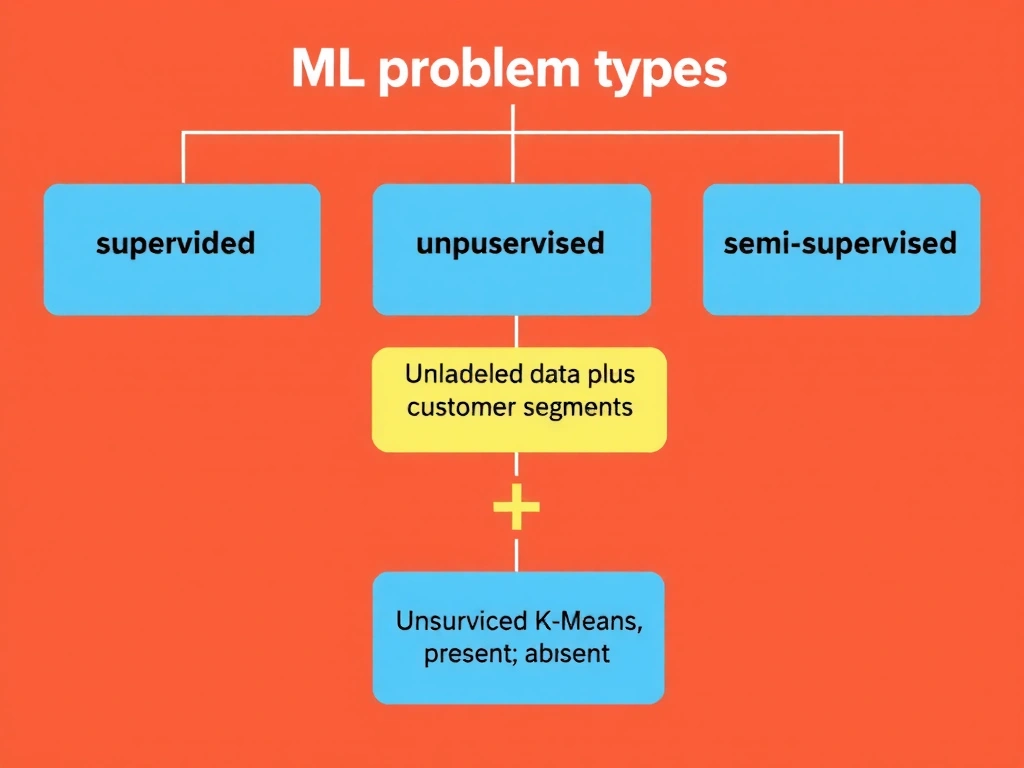
Full Explanation
Customer segmentation without predefined segment names is a classic unsupervised learning problem. Unsupervised methods discover structure in unlabeled data; clustering algorithms partition observations so that members of a cluster are more similar to each other than to members of other clusters. K-Means is widely used for this purpose: it assigns each point to one of K centroids and iteratively updates centroids to minimize within-cluster variance, typically using Euclidean distance in a feature space of purchase history, demographics, engagement metrics, and related signals.
Supervised approaches such as logistic regression require a labeled target—for example, whether a customer churned or responded to a campaign. That does not match a brief that only asks for natural segments without labels. Semi-supervised learning sits between the two worlds: a small labeled set plus a large unlabeled set. If no segment labels exist at all, semi-supervised trees are not the primary fit. Reinforcement learning, including Q-learning, addresses sequential decision-making under reward signals in an environment; it is not the default tool for offline static grouping of customer records.
In practice, teams choose K, scale features carefully, and validate clusters with business interpretability and metrics such as silhouette scores, then map clusters to campaign treatments. Alternatives such as hierarchical clustering, DBSCAN, or Gaussian mixtures may suit other distance or density assumptions, but when the exam pairs unlabeled segmentation with a standard algorithm, K-Means under unsupervised learning is the expected answer. Remember the mapping: labels present means supervised classification or regression; labels absent and the goal is groups means unsupervised clustering; agent, actions, and rewards means reinforcement learning.
On multiple-choice items, watch for distractors that name a familiar algorithm from the wrong paradigm. Logistic regression is excellent for binary outcomes once labels exist, but it cannot invent segment labels from nothing. Likewise, Q-learning is the wrong tool when there is no interactive reward loop. Match the data condition first—no labels—then pick clustering, and K-Means is the canonical named method for this scenario.