
Which statement best captures the main characteristic of weak AI (also called narrow AI)?
Select an answer to reveal the explanation.
Short Explanation and Infographic
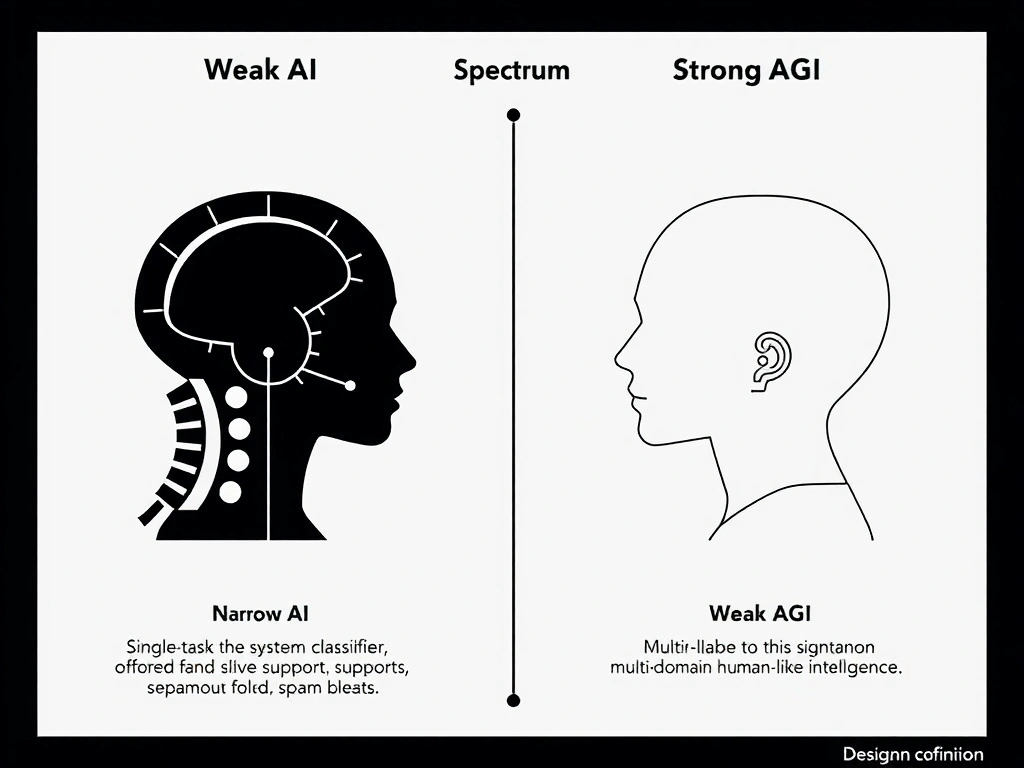
Check this out — almost every AI system you actually ship is weak AI. Not weak as in useless — weak as in narrow. One job, done well: classify tickets, rank products, detect defects. Think of it like a specialist contractor, not a general employee who can do every role in the company. Strong AI or AGI would be the human-like generalist with broad reasoning — we're not there as a product category. Consciousness? Not the exam definition. RLHF is a training method, not what makes AI weak. Trap: people hear weak and think broken. On the test, weak equals single specific task. Land that takeaway and you're solid.
Full explanation below image
Full Explanation
Weak AI, also known as narrow AI, refers to systems designed and optimized for a limited, well-specified objective. Speech-to-text models, fraud detectors, medical image classifiers for a particular modality, and recommendation engines are typical examples. These systems may be highly capable within their domain, yet they do not autonomously transfer human-level understanding across arbitrary tasks. That specialization is the defining characteristic tested in foundational AI literacy and related curricula.
By contrast, strong AI or artificial general intelligence would match or exceed human cognitive flexibility across many domains—an aspirational research goal rather than the everyday systems organizations deploy. Consciousness, self-awareness, or subjective experience are philosophical and scientific topics that are not required properties of narrow AI products. Similarly, techniques such as reinforcement learning from human feedback improve alignment or preference modeling for some models; they do not redefine the weak-versus-strong distinction.
For exam purposes, map vocabulary carefully: weak or narrow means task-specific competence; strong or general means broad human-like capability. Do not confuse marketing claims of powerful AI with the technical category of weak AI—power within a niche still leaves the system narrow. When evaluating options, reject any answer that equates weak AI with AGI, consciousness, or a single training recipe. Remember a practical check: if the system fails outside a defined scope and cannot reassign itself to unrelated open-ended goals the way a person can, it is weak AI—and that covers virtually all commercial machine learning applications today.
A second practical check is historical and product oriented: chatbots tuned for customer support, vision models that only grade one defect type, and ranking models for one catalog are all weak AI even when they use large neural networks. Scale of parameters does not by itself create strong AI. On the exam, choose the option that stresses a single specific task over human-like general reasoning.