
A data science team is preparing a high-dimensional customer dataset for a predictive model. Which statement best describes the purpose of feature selection?
Select an answer to reveal the explanation.
Short Explanation and Infographic
Okay, let's dive in. Feature selection is about choosing which columns actually help the model — not inventing new ones, not deleting duplicate rows. Think of it like packing for a trip: you don't take every shirt you own; you pick the ones that matter so you're not dragging a heavy suitcase of noise. Pay close attention here, because folks mix this up with feature engineering all the time. Engineering builds or transforms variables; selection decides which variables stay. On the exam, if they say most relevant features from the dataset to improve performance, that's selection. Got it? Sweet — keep the signal, drop the junk columns.
Full explanation below image
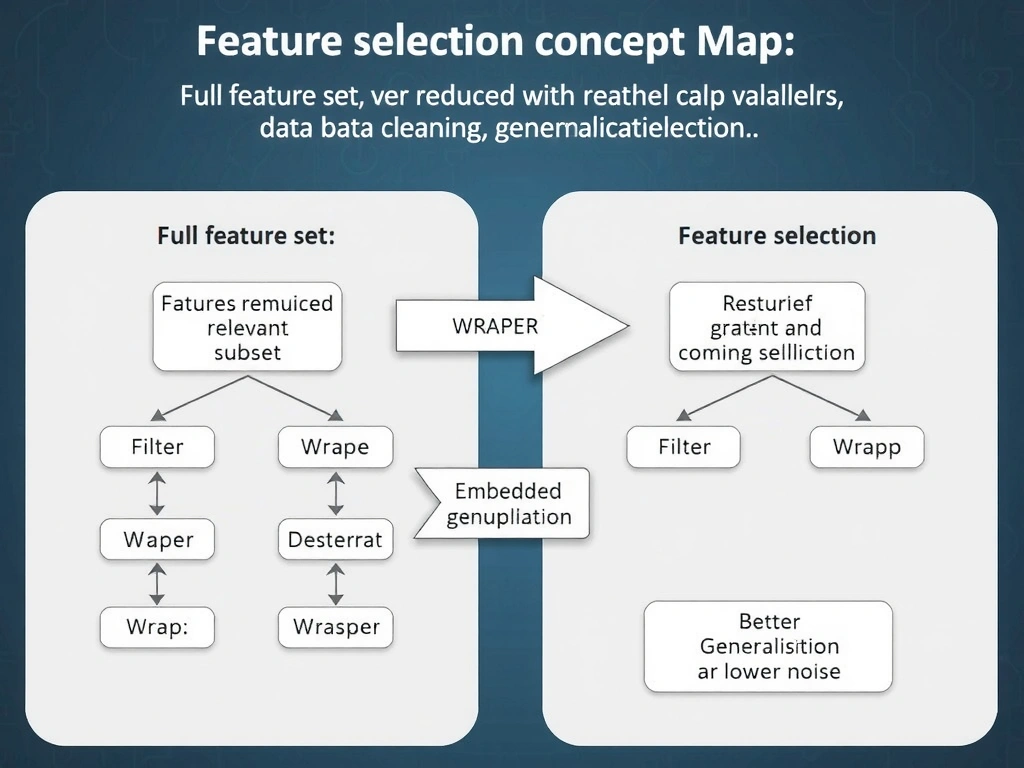
Full Explanation
Feature selection is the process of choosing a subset of the available input variables that are most useful for the learning task. In high-dimensional settings, many columns may be irrelevant, redundant, or noisy. Including them can increase training cost, inflate variance, and hurt generalization. By retaining predictors that carry signal relative to the target, or that reduce redundancy among themselves, practitioners often obtain leaner models that train faster and perform better on unseen data.
It is important to distinguish feature selection from related preprocessing steps. Feature construction or feature engineering creates new variables—for example ratios, embeddings, or polynomial terms—from existing data. Deduplication removes repeated records and belongs to data cleaning. Product-level feature scoping, meaning what the application should support, is unrelated to columns in a training matrix. Selection specifically answers: among the candidate inputs we already have, which should the model use?
Methods range from filter approaches with statistical scores independent of a particular model, through wrapper methods that search subsets guided by model performance, to embedded methods such as sparsity or importance estimates during training, including L1 regularization. Regardless of technique, the goal remains the same: improve the signal-to-noise ratio of the input space. In practice, teams also monitor leakage, stability of selected sets across folds, and fairness impacts when dropping variables that proxy protected attributes.
For certification-style questions, map the stem to this core idea: feature selection chooses the most relevant and important features to support better model performance. If the option instead describes creating features, cleaning duplicates, or product design, it is a distractor. Remember the triad: clean the data, engineer features when needed, then select which features to keep—and always validate that the reduced set still generalizes. A practical check on the exam is to ask whether the option is about choosing columns, inventing columns, cleaning rows, or scoping a product. Only the first maps to feature selection.