
In reinforcement learning, what is the main objective of Q-learning?
Select an answer to reveal the explanation.
Short Explanation and Infographic
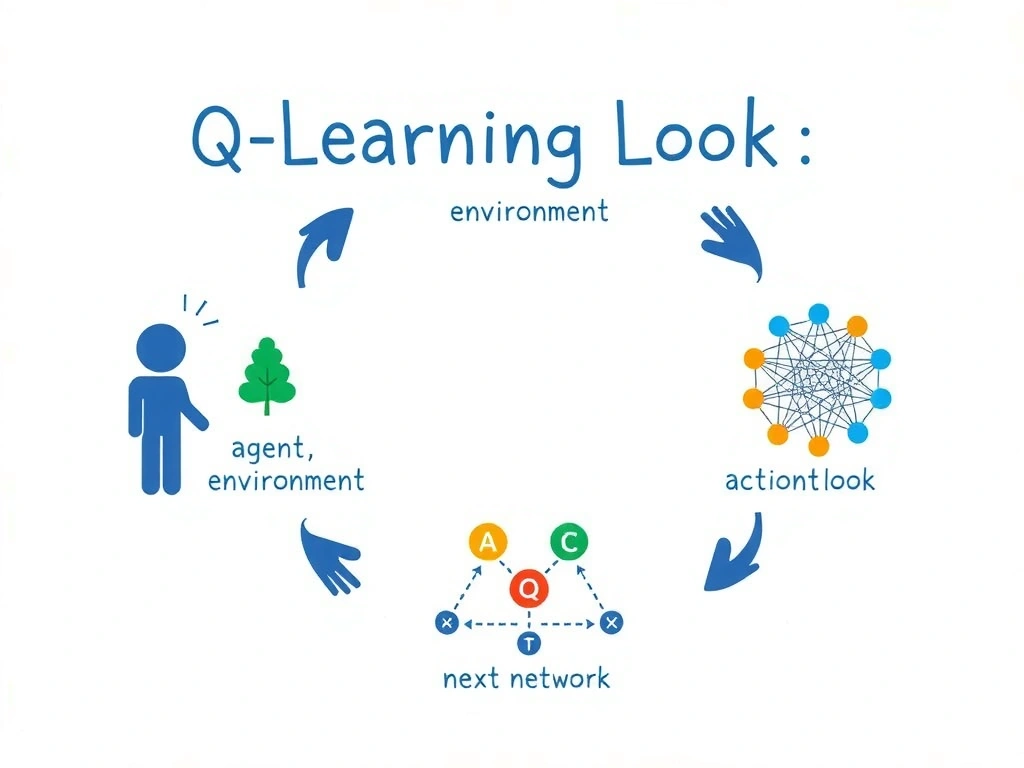
Let's dive into Q-learning without the fog. Agent is in a state, picks an action, gets a reward, lands in a new state — rinse and repeat. Q-learning's job is to fill in a cheat sheet: "from this state, how good is each action, long-term?" That's Q(s, a). Once the sheet is solid, the policy is basically "pick the action with the best Q." Think of it like learning which restaurant choice pays off over a whole trip, not just the first bite. Not clustering. Not "make the state space smaller" as the main mission. Not plain regression on random numbers. Exam trap: mixing Q-learning with unsupervised grouping. Rewards and actions are the heartbeat. Objective = learn the action-value function for an optimal policy. Got it? Sweet.
Full explanation below image
Full Explanation
Q-learning is a foundational model-free reinforcement learning algorithm. An agent interacts with an environment formalized through states, actions, transition dynamics, and scalar rewards over time. The action-value function Q of state s and action a estimates the expected discounted return of taking that action in that state and thereafter following an optimal policy. Q-learning updates these estimates from temporal-difference errors using sampled transitions of state, action, reward, and next state, typically with a learning rate and a discount factor. Importantly, the method is off-policy: it can learn about the greedy optimal policy while the behavior policy still explores, for example with epsilon-greedy action selection.
The main objective is therefore not unsupervised clustering of states, nor is dimensionality reduction of the state space the defining goal, though function approximation with linear methods or deep Q-networks may represent Q over large or continuous spaces. Predicting an arbitrary continuous label without reference to actions and cumulative reward is supervised regression, which lacks the sequential decision structure that defines reinforcement learning problems.
Once Q values are accurate enough, an optimal policy is recovered by acting greedily, choosing in each state the action with the largest Q value. Convergence results for tabular Q-learning assume sufficient exploration of state-action pairs and appropriate step-size conditions. In practice, engineers monitor episodic returns, temporal-difference error, and exploration schedules, and they design reward functions carefully because Q-learning optimizes the reward signal it is given rather than an implicit human intent.
Exam memory aid: Q stands for the quality of an action in a state, and learning Q enables selection of an optimal policy. If an option mentions clusters, pure feature compression, or labeled continuous prediction without rewards and actions, it is describing a different machine learning paradigm. Choose the action-value and optimal-policy wording for Q-learning every time you see this topic on the exam.