
How do artificial intelligence (AI) and machine learning (ML) relate as fields of study?
Select an answer to reveal the explanation.
Short Explanation and Infographic
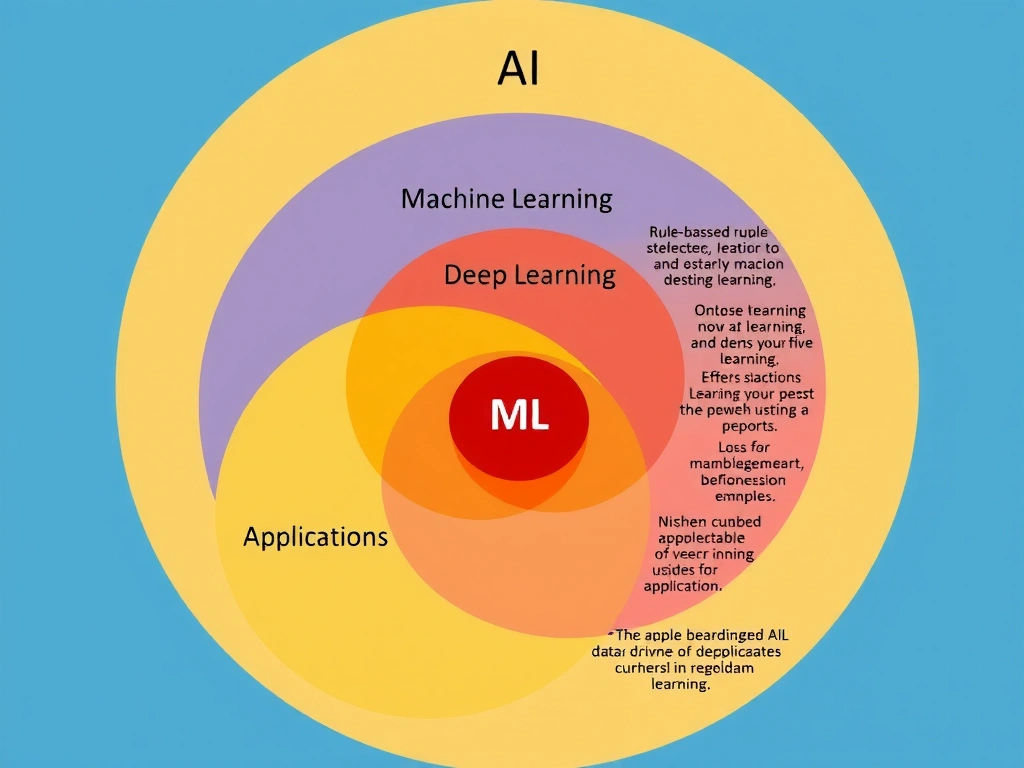
Here's the deal — people mash "AI" and "ML" together in marketing, but the exam wants the hierarchy. AI is the big tent: anything that makes machines act smart — rules, search, planning, vision, robots, the works. Machine learning lives inside that tent: systems that get better from data instead of you writing every rule by hand. Think of AI as "transportation" and ML as "cars" — related, not identical. Trap one: saying there's zero difference. Trap two: AI is only theory and ML is only practice — both have labs and papers. Trap three: AI equals only rules, ML equals only data, as if they never meet. Reality: data-driven models are a huge slice of modern AI. Takeaway: AI ⊃ ML. Simple Venn diagram, huge exam points.
Full explanation below image
Full Explanation
Artificial intelligence is the broad scientific and engineering field concerned with creating systems that perform tasks associated with intelligent behavior—perception, reasoning, planning, language, decision-making, and interaction with the world. Approaches historically include symbolic logic, expert systems, heuristic search, probabilistic reasoning, robotics control, and, increasingly, statistical learning.
Machine learning is a core subfield of AI that studies algorithms whose performance on a task improves with experience or data. Supervised, unsupervised, and reinforcement learning are major ML paradigms. Deep learning is a further specialization within ML using multi-layer neural networks. Thus the standard relationship is nested: deep learning ⊂ machine learning ⊂ artificial intelligence, with other non-learning AI techniques still part of the outer set.
Claiming AI and ML are identical erases decades of non-learning AI and confuses product branding with taxonomy. Treating AI as pure theory and ML as pure practice is also incorrect: AI has highly applied deployments (planners in logistics, rule engines in business software), and ML has deep theoretical foundations (statistical learning theory, optimization). Framing AI as only rule-based and ML as only data-driven sets up a false dichotomy; data-driven ML systems are AI systems, and hybrid neuro-symbolic designs intentionally combine both styles.
For certification questions, prefer the "broad field versus data-learning subset" wording. When a system learns weights from examples, you can call it ML (and AI). When a system uses only hand-authored rules with no learning, it may still be AI but not ML. That distinction keeps marketing hype from muddying technical answers and aligns with how textbooks and exam objectives organize the landscape. Draw the nested Venn diagram once, and the relationship becomes hard to forget on test day.