
What is the primary goal of clustering algorithms in machine learning?
Select an answer to reveal the explanation.
Short Explanation and Infographic
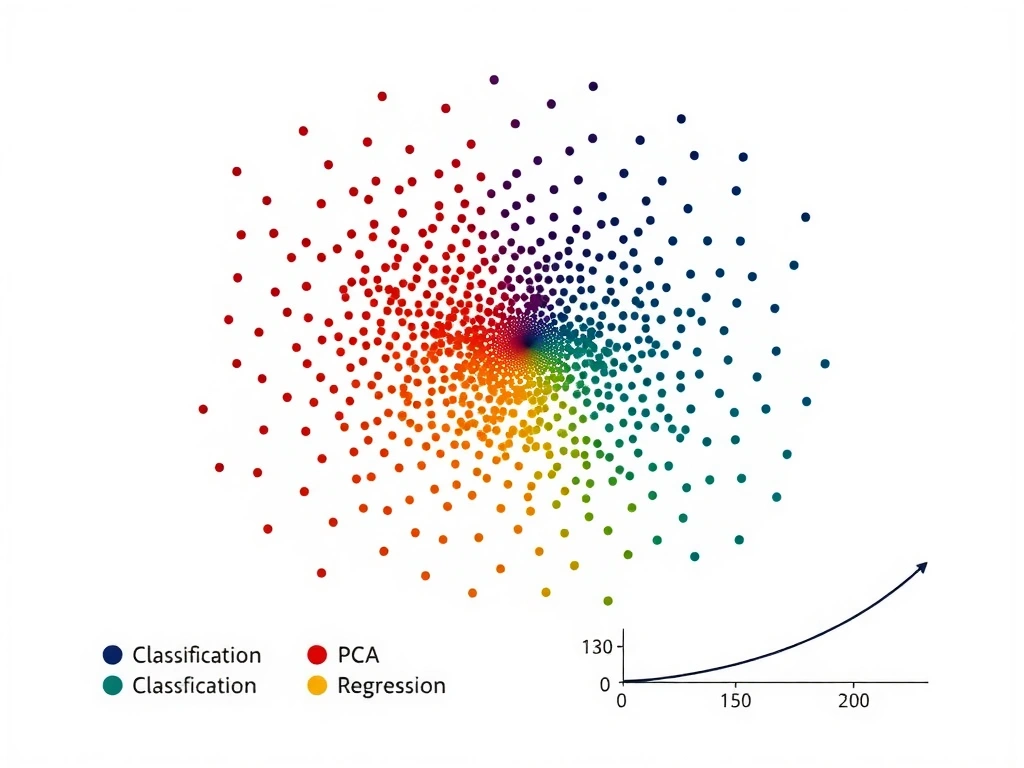
Okay, clustering is the "sort the junk drawer without labels" skill. Nobody hands you a sticky note saying "these are customers type A." You just group things that look alike — same spending pattern, same sensor signature, same document vibe. Think of it like seating strangers at wedding tables by shared interests, not by a preprinted guest list of categories. Classification needs those labeled categories. PCA-style methods shrink features. Regression predicts numbers. Exam trap: calling clustering "classification without saying labels." Close emotionally, wrong technically. Primary goal = form groups of similar unlabeled points. If the stem says no labels and groups, you're in clustering land. Nice and clean.
Full explanation below image
Full Explanation
Clustering is an unsupervised learning task whose main objective is to group data points so that members of the same cluster are more similar to each other than to members of other clusters, according to a chosen distance or similarity measure. Labels for the groups are not provided in advance; the algorithm discovers structure from the geometry or density of the data itself. Common methods include k-means, hierarchical clustering, DBSCAN, and Gaussian mixture models, each encoding different assumptions about cluster shape, count, and noise handling.
This goal differs sharply from supervised classification, which maps inputs to a predefined label set using labeled training pairs and evaluates accuracy or related classification metrics. Clustering may later support labeling or customer segmentation workflows, but discovering the partitions themselves does not require class names up front. Dimensionality reduction seeks a lower-dimensional representation that preserves information or structure; it can be a helpful preprocessing step before clustering but is not clustering's primary aim. Regression predicts continuous targets and also needs supervised numeric targets for training, which clustering does not use.
Practitioners choose similarity metrics carefully, scale features so no single dimension dominates distance, and validate clusters with internal indices such as silhouette or Davies-Bouldin scores, or with external labels when they become available for post-hoc checks. Business uses include customer segmentation, anomaly grouping, image region grouping, document topic discovery, and exploratory analysis before supervised modeling. Exam cue: words like unlabeled, groups, and similar points point to clustering; predefined categories point to classification; fewer features point to dimensionality reduction; continuous output points to regression. Keep those four lanes separate and the correct objective stays clear on test day.