
For a regression model, what does a low mean absolute error (MAE) tell you about performance?
Select an answer to reveal the explanation.
Short Explanation and Infographic
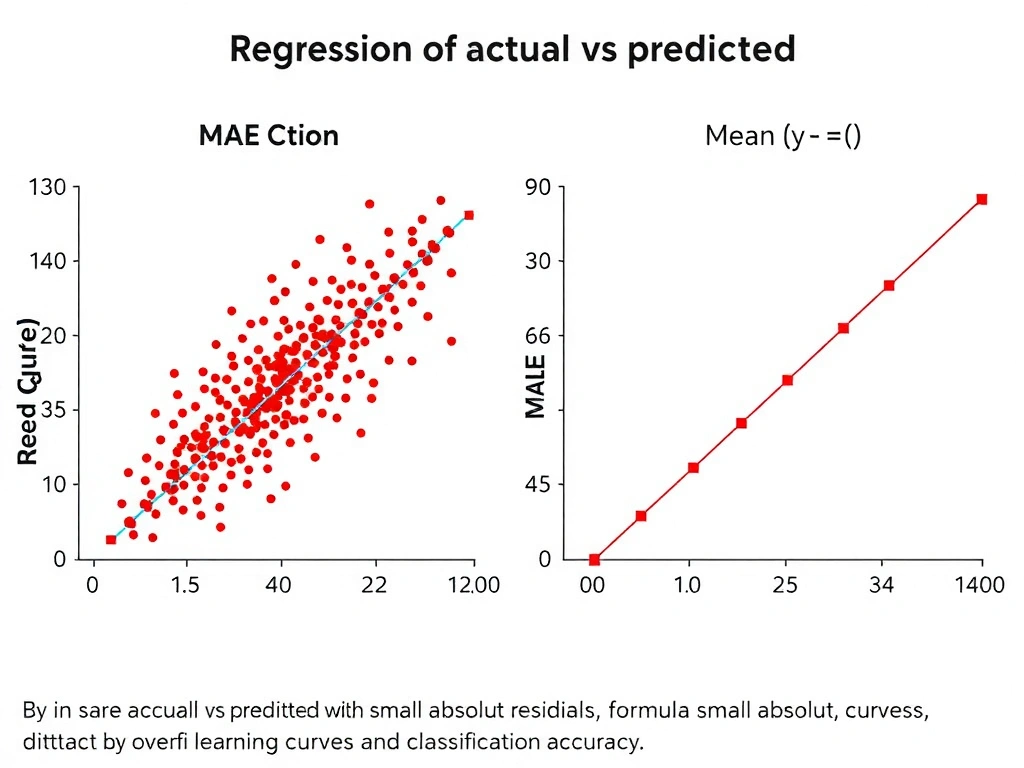
Here's where metrics get practical. MAE is dead simple: take absolute misses, average them. Low MAE means your guesses are usually close to the real numbers — same units as the target, which your boss will love. Think of it like missing the bullseye by two centimeters on average versus twenty. Exam trap number one: equating low MAE with "overfit." Overfit is about train-versus-test gaps, not a single low number. Trap two: calling MAE "accuracy" like classification. Different game. Trap three: saying low MAE means high bias — that's backwards. If you're close on average, you're not living in high-bias failure land. Takeaway: low MAE → predictions close to actuals on average. Clean and usable.
Full explanation below image
Full Explanation
Mean absolute error summarizes regression quality as the average of absolute residuals, commonly written MAE equals the mean of absolute differences between each observed target and its prediction. Because absolute deviations are not squared, MAE is relatively robust to extreme outliers compared with mean squared error, and it remains in the same units as the target variable, which aids interpretation for stakeholders who need an intuitive error magnitude.
A low MAE indicates that, across the evaluation set, predictions are typically near the true values in absolute magnitude. That is a direct statement about average absolute closeness of continuous estimates to ground truth. It does not automatically mean the model overfit the training sample. Overfitting requires evidence that performance is strong on training data yet weak on unseen data; a low MAE on a proper validation or test set is desirable, not suspicious by itself. Conversely, a low training MAE paired with a high test MAE would suggest overfit and poor generalization.
MAE is not classification accuracy. Accuracy counts exact class matches for categorical outputs; applying that language to MAE confuses regression with classification problem types. High bias implies the model systematically fails to capture the true relationship and usually produces larger errors on average; observing low MAE argues against a severe high-bias story on that evaluation set, though you should still inspect residual plots for remaining structure or heteroscedasticity.
Best practice is to report MAE alongside complementary metrics such as RMSE, R-squared, and quantile errors, and always specify which dataset split was scored. For skewed targets or asymmetric costs, consider median absolute error or custom losses that match business risk. Exam cue: when the stem mentions regression and low MAE, choose the interpretation that predictions are on average close to actual values, not overfit, not classification accuracy, and not high bias.