
In a support vector machine (SVM), what are support vectors?
Select an answer to reveal the explanation.
Short Explanation and Infographic
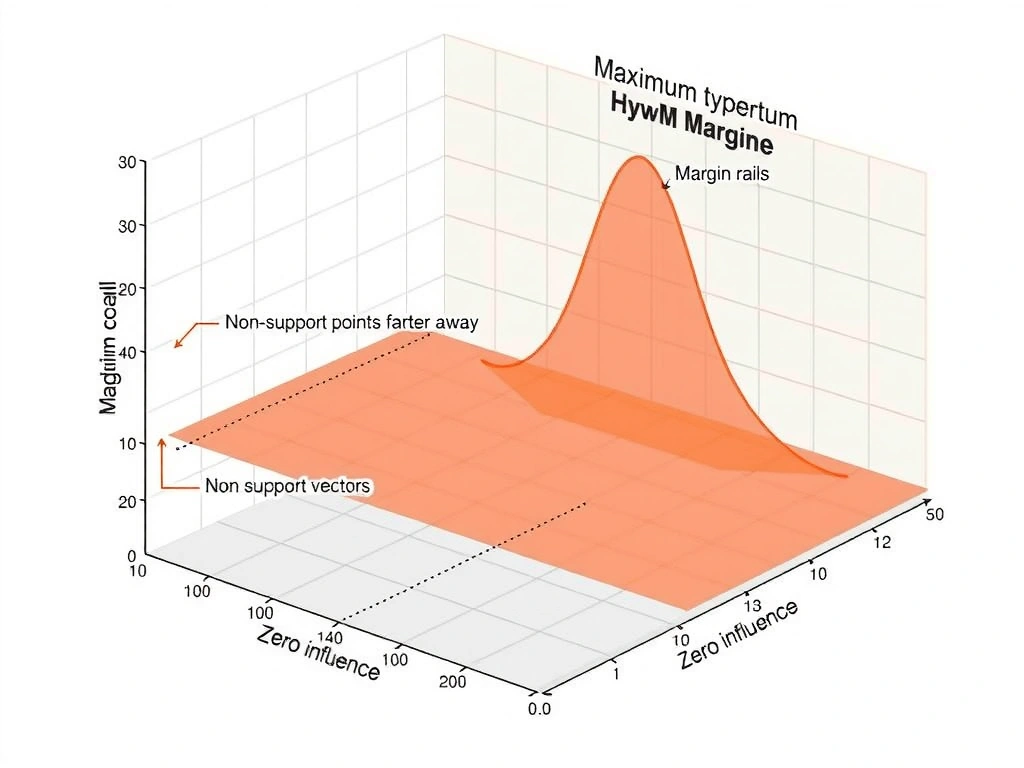
Let's talk SVM like we're at a whiteboard. The hyperplane is the decision fence; the margin is the buffer on both sides. Support vectors? They're the data points camping right on that margin (or violating it a bit in soft-margin land) that hold the fence in place. Think of tent poles — only a few poles matter; the rest of the camp can move and the tent still stands. Far-away points? Not poles. Scaling helpers? Different job. Random outliers to trash? Not the definition. Exam trap: thinking every point shapes the boundary. Nope — SVM solutions are sparse in the dual: non-support points get coefficient zero. Remember: support vectors define the margin. That's the whole punchline.
Full explanation below image
Full Explanation
Support vector machines find a decision boundary—a hyperplane in the feature space (or a kernel-induced space)—that maximizes the margin between classes while controlling misclassification via soft-margin slack when needed. In the dual formulation, each training example receives a coefficient. Only examples with nonzero coefficients contribute to the expansion of the weight vector; those examples are the support vectors.
Geometrically, support vectors lie on the margin boundaries or, under soft margins, within the margin or on the wrong side of the hyperplane when slack is used. Because the solution depends only on these points, the SVM decision function is determined by a typically small subset of the training data. That property yields sparsity and can make SVMs relatively robust to many non-boundary examples.
Support vectors are not tools for scaling data. Feature standardization is performed before or outside the core SVM optimization and uses global feature statistics, not a special class of "support" points. Points far from the boundary generally receive zero dual weight and can be removed without changing the fitted hyperplane. Misclassified or noisy points might become support vectors and influence the soft-margin solution; they are not definitionally "outliers that must be deleted," nor is every outlier a support vector by name alone.
For practice and exams: when asked what a support vector is, answer with margin-defining training instances that fix the hyperplane. Contrast with k-NN (all points may matter locally), logistic regression (all points contribute to the likelihood), and pure preprocessing concepts. Visualize two classes, a thick margin, and a handful of bold points on the rails—that mental picture is the support-vector idea. If a choice describes scaling helpers, distant points, or pure outlier deletion, it is missing the margin-defining role of support vectors.