
During supervised training, what primary job does the loss function perform?
Select an answer to reveal the explanation.
Short Explanation and Infographic
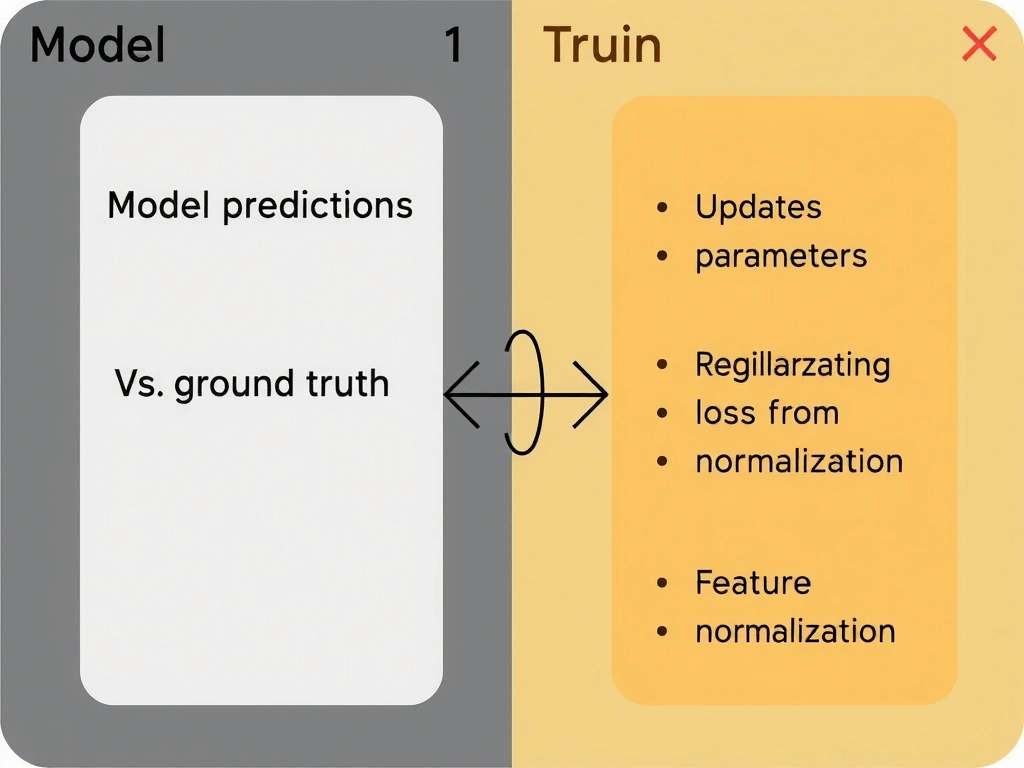
Check this out: the loss function is how your model gets graded every training step. Predictions go in, true labels go in, and out comes a number that says "how wrong were we?" Optimizers live for that number — they nudge weights to drive it down. Think of it like a coach's scorecard, not the stretch routine that stops you from overtraining. Overfitting controls, feature scaling, feature selection — those are different tools. Exam trap is treating "loss" like a synonym for regularization or preprocessing. Don't. Loss measures error between ŷ and y. Cross-entropy, MSE, MAE — same idea, different scorecards. Land this: no clear loss, no clear learning signal.
Full explanation below image
Full Explanation
In supervised machine learning, training adjusts model parameters so predictions align with observed targets. The loss function formalizes that alignment: it maps a batch of predictions and ground-truth labels to a scalar (or per-example values that are aggregated) reflecting discrepancy. Mean squared error and mean absolute error are common for regression; cross-entropy and hinge losses are common for classification. The optimizer—SGD, Adam, and related methods—uses gradients or other updates of this objective with respect to parameters to improve the model.
Although a training objective may include regularization terms (for example L2 weight penalties) that discourage overfitting, the loss's defining role is still error measurement and optimization guidance. Overfitting is mitigated by capacity control, more data, dropout, early stopping, and careful validation—not merely by "having a loss." Likewise, normalizing inputs is a data-preparation concern that changes the scale of features; it is not how the model scores prediction quality. Feature selection chooses which inputs enter the model; that process may use separate criteria or models, but it is not what "loss function" means in the training loop.
Choosing an appropriate loss matters: it encodes assumptions about noise and the cost of different mistakes (for example class-weighted cross-entropy for imbalance). Monitoring train and validation loss curves also diagnoses underfitting, overfitting, and optimization failures. Memory aid: features feed the model, the model emits predictions, the loss compares predictions to labels, and the optimizer updates parameters from that signal. On certification items, pick the option that says the loss quantifies predicted-versus-actual error for training, and reject options that confuse loss with preprocessing, feature ranking, or a standalone anti-overfitting device. The loss is the scorecard of training, not the entire training strategy.