
Under the bias–variance trade-off, which description best fits a model that exhibits high bias and low variance?
Select an answer to reveal the explanation.
Short Explanation and Infographic
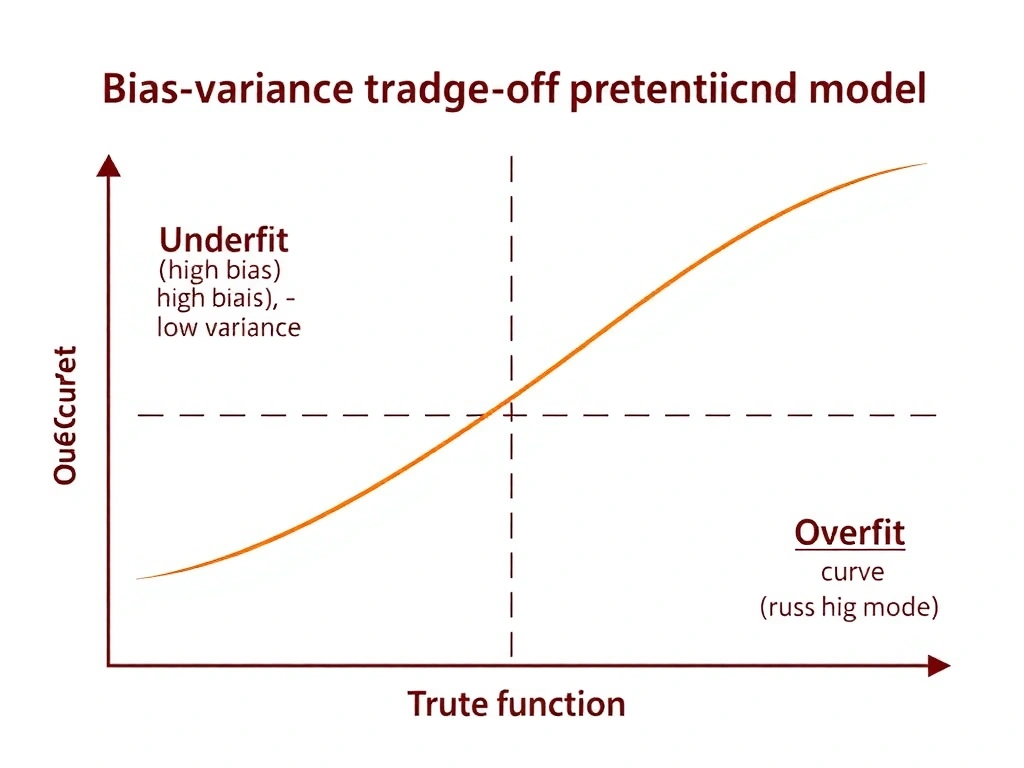
Okay, let's dive in. High bias, low variance — that's your stubborn, oversimplified model. Think of it like this: you're fitting a straight line to a clearly curved path. It misses the shape the same way every time (high bias), but it doesn't thrash around when you swap training folds (low variance). That's underfitting, plain and simple. Exam trap? People flip it and call high bias "overfitting." Nope — overfitting is the jumpy, high-variance kid that memorizes noise. Perfect generalization? That's the middle ground you're aiming for, not high bias. And compute cost? Totally different conversation. Remember: high bias ≈ too simple ≈ underfit. Stick that in your pocket for the test.
Full explanation below image
Full Explanation
The bias–variance trade-off decomposes expected prediction error into error from incorrect assumptions (bias), sensitivity to the particular training sample (variance), and irreducible noise. A model with high bias and low variance systematically misses the true function yet produces similar predictions when retrained on different draws of data. That pattern is the definition of underfitting: the hypothesis class or regularization is too restrictive to represent the signal.
Typical examples include linear regression on a strongly nonlinear relationship, a decision stump on a complex decision boundary, or aggressive regularization that collapses flexible models toward a crude average. Training and validation errors both tend to be high, and collecting more data of the same kind often helps only modestly until capacity increases or features improve.
High computational cost is not a bias–variance label. Large neural nets can be expensive yet low-bias; tiny linear models can be cheap yet high-bias. A "perfectly generalized" model would sit near the sweet spot of the trade-off, not in the high-bias corner. Overfitting is the opposite profile: low training error, high variance across samples, and poor transfer to new data because noise was memorized.
Practically, diagnose high bias with learning curves that show high error even as training set size grows, then respond by enriching features, increasing model capacity, relaxing regularization, or training longer when optimization underfits. For the exam, map the four-way intuition cleanly: high bias/low variance → underfit; low bias/high variance → overfit; balanced → better generalization. That mapping is more reliable than vague talk of accuracy alone. Keep the corner cases straight and you will avoid the most common bias-variance traps on certification items and in model debugging reviews.