
A team is deploying a vision model that must identify pedestrians, signs, and vehicles from camera streams on an autonomous vehicle. For safe, closed-loop control at highway speeds, which system property matters most?
Select an answer to reveal the explanation.
Short Explanation and Infographic
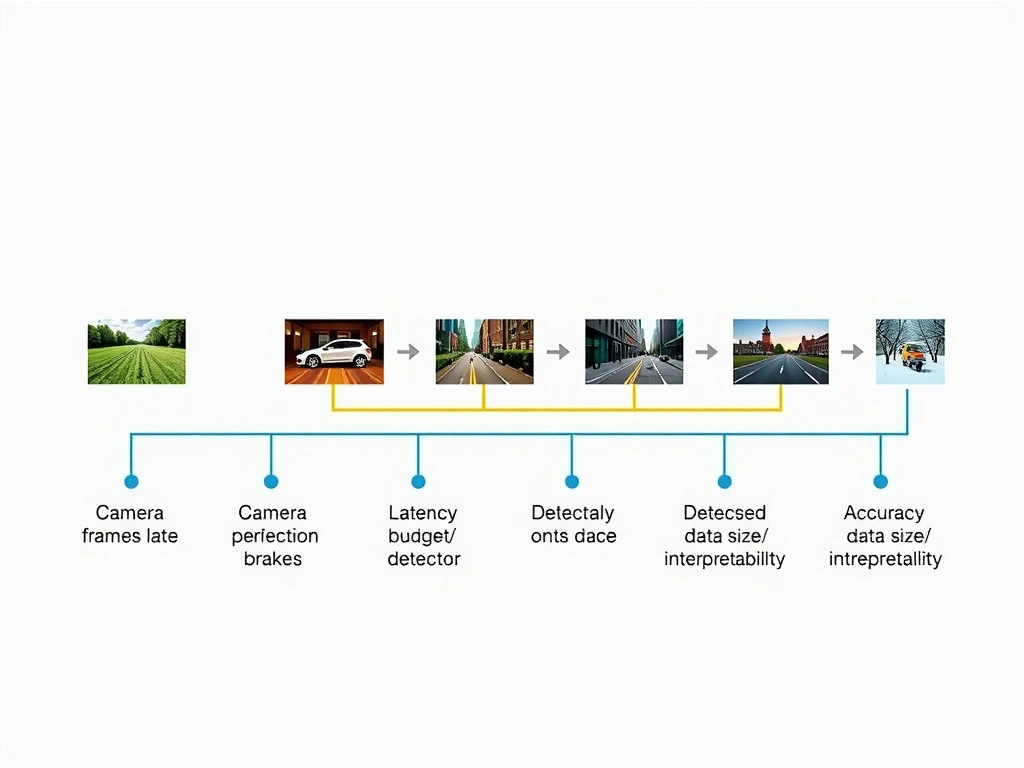
Here's the deal: your self-driving stack can be brilliant on paper and still be dangerous if it's late. Think of it like this — spotting a pedestrian after you've already driven past them doesn't help anyone. Boss walks in and says, "We need detections that keep up with the road," and what they're really asking for is low latency and high inference speed. Big training sets? Nice for accuracy later. Interpretability? Great for audits. Model recycling? Ops problem. None of those replace getting the answer now. On the exam, when you see live video, autonomous control, or closed-loop safety, lock onto real-time inference. Got it? Sweet — latency is the life-critical knob here.
Full explanation below image
Full Explanation
In autonomous driving and similar closed-loop perception systems, correctness without timeliness is insufficient for safety. The vehicle continuously integrates sensor observations into planning, control, and actuation loops that run under hard time budgets. If object detections arrive after the relevant window for braking or steering has passed, even an accurate label fails to support safe behavior in the physical world. Therefore, low end-to-end latency and high inference throughput are the most critical properties for safe real-time operation of a live video detector on the vehicle.
Latency here includes sensor capture, preprocessing, model forward pass, post-processing such as non-maximum suppression, and handoff to the planner. Engineers often trade model capacity, input resolution, and batching strategy to meet a hard timing budget measured in tens of milliseconds at highway speeds. Edge deployment may further require quantization, pruning, or specialized accelerators so the model sustains frame rates under thermal and power limits without dropping critical frames.
A very large training set can improve generalization and reduce certain failure modes, but dataset scale primarily affects offline learning quality, not whether each inference finishes before the next control cycle. Interpretability helps engineers and regulators understand decisions and debug rare failures; it does not by itself deliver the temporal guarantees required on the road. Rapid model recycling or reinstallation is an MLOps convenience and is orthogonal to continuous, in-trip perception performance while the vehicle is moving.
Exam and design takeaway: when a scenario stresses live video, vehicle control, or safety under motion, prioritize inference speed and latency bounds over secondary virtues such as data volume, explainability, or redeploy logistics. Accuracy still matters a great deal in perception stacks, but among the listed choices, timely inference is what keeps perception usable for safe real-time decisions. Memory aid: a right answer at the wrong time is still a system failure in autonomous control.