
In a production ML platform, what is the main role of a feature store?
Select an answer to reveal the explanation.
Short Explanation and Infographic
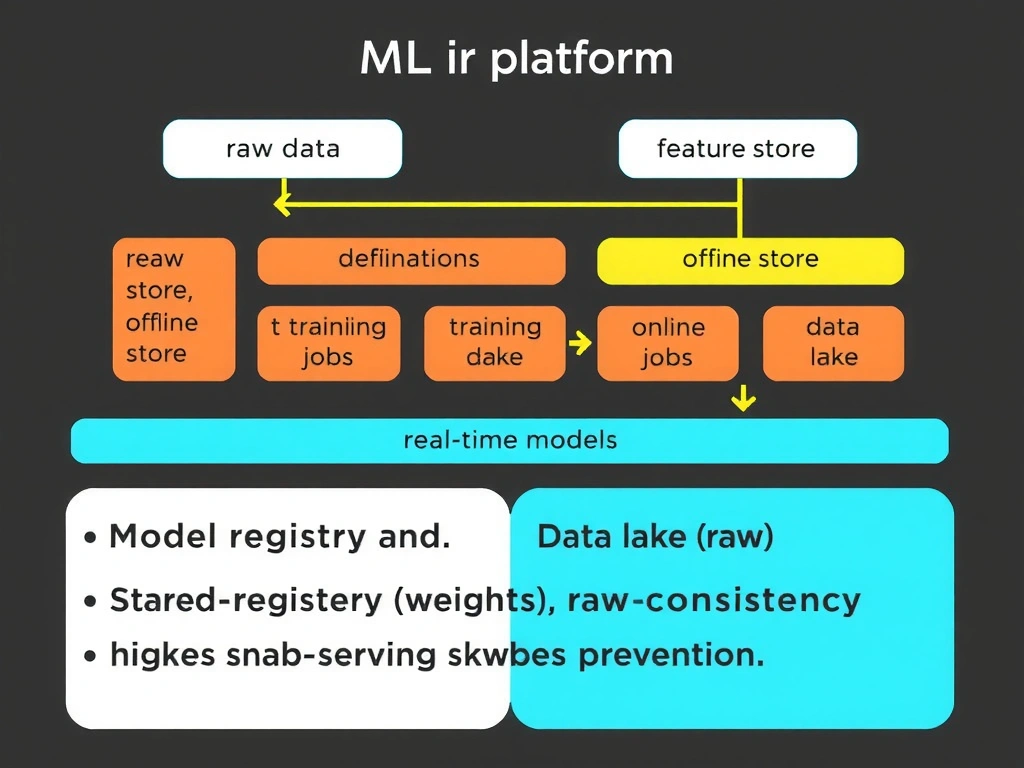
Imagine your boss walks in: "Why did offline training use yesterday's features but the API used something else?" That's training–serving skew, and feature stores exist to crush it. A feature store is the shared pantry for ML features—define them once, compute them consistently, serve them for batch training and low-latency inference. Not a UI diagram tool. Not the model weight vault. Not just a raw data swamp. Exam trap: hearing "features" and thinking product features or model parameters. In MLOps, features mean model inputs. Centralize them, version them, serve them. Trust me—this is how teams scale without chaos.
Full explanation below image
Full Explanation
A feature store is an MLOps component that centralizes the lifecycle of machine learning features: definition, transformation logic, storage, access control, discovery, and serving. During training, data scientists retrieve historical feature vectors with point-in-time correctness so labels join to feature values that would have been available at prediction time, avoiding label leakage from future information. During online inference, applications fetch the latest feature values with low latency using the same semantic definitions. This dual serving pattern reduces training–serving skew, duplication of transformation code across notebooks and microservices, and inconsistent metrics when teams reimplement the same business logic differently. In multi-team organizations, a feature store also becomes a catalog so people can reuse battle-tested features instead of reinventing joins and window aggregations.
That repository-and-serving role is distinct from several look-alike systems. Product analytics dashboards that visualize application functionality are unrelated to ML feature materialization. Model registries or object stores hold serialized parameters such as neural network weights and biases, not reusable input features consumed by many models. Raw data lakes retain source events and tables; feature stores sit above raw data, materializing curated features, often with time-travel or snapshot semantics, documentation, lineage, and quality checks. Confusing these layers is a common architecture mistake on exams and in greenfield platforms.
Adoption best practices include clear feature ownership, validation tests for null rates and drift, consistent entity keys such as user, device, or account, and governance for personally identifiable information. Monitor offline versus online parity so production scores do not silently diverge from offline experiments. Memory aid: data warehouse or lake holds raw and analytical tables; the feature store holds ML-ready inputs shared across train and serve; the model registry holds trained artifacts. Knowing which shelf holds which asset is essential for reliable production machine learning and for answering certification questions about platform architecture.