
What is the primary practical advantage of ensemble methods such as Random Forests or gradient boosting machines?
Select an answer to reveal the explanation.
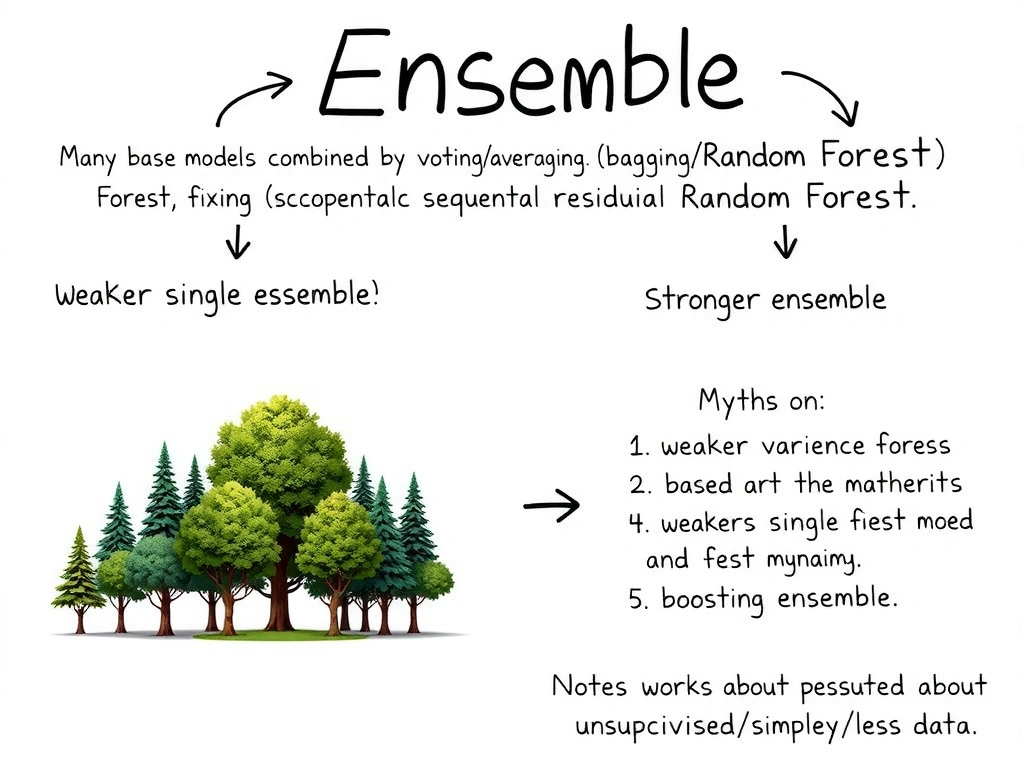
Short Explanation and Infographic
Here's where ensembles shine. One tree can be a drama queen—high variance, overfit city. A forest of trees voting together? Usually calmer, stronger predictions. Boosting chains models that fix each other's mistakes. Think of asking a whole panel of specialists instead of one intern. That's the advantage: better performance, often less overfitting than a lone weak learner. They're not unsupervised clustering. They don't guarantee great results on tiny data. And "simpler to interpret"? Usually the opposite of a single tree. Exam trap: assuming ensembles are easier and cheaper. They're powerful, not free. Remember—combine models, cancel errors. Got it?
Full explanation below image
Full Explanation
Ensemble methods construct a predictive model by combining multiple base learners. Bagging-style methods such as Random Forests train diverse trees on bootstrap samples and random feature subsets, then average or vote; this mainly reduces variance and stabilizes predictions. Boosting methods such as gradient boosting build models sequentially, each focusing on residual errors of the current ensemble, which primarily reduces bias while careful regularization (learning rate, depth limits, subsampling, early stopping) controls overfitting. Across tabular and many structured problems, these approaches frequently outperform a single unconstrained tree or linear model when tuned properly. The core idea is statistical: diverse errors cancel when models are aggregated, so the committee is often stronger than any one member.
That performance-and-generalization benefit is the primary practical advantage referenced in exam settings. Ensembles are not defined as unsupervised clustering; while trees can appear in unsupervised contexts, Random Forest and gradient boosting classifiers and regressors are supervised workhorses trained on labeled targets. They also do not universally require less data—high-capacity ensembles can overfit small noisy sets without regularization, shrinkage, or early stopping. Interpretability and training simplicity are often worse than for a single decision stump or shallow tree: feature importances and SHAP values help explain contributions, but the combined model remains more complex to reason about and to debug when something fails in production.
Best practices include validating with cross-validation, monitoring train–validation gaps, using appropriate loss functions for class imbalance, and comparing ensembles against strong baselines before celebrating gains. Watch compute and latency budgets, because hundreds of trees cost more to train and serve than one linear model. Memory aid: bagging averages noisy experts to cut variance; boosting acts like a tutor fixing mistakes to cut bias; both beat one fragile student model more often than not—if you regularize carefully and evaluate honestly on held-out data.