
Which statement correctly contrasts supervised learning with reinforcement learning?
Select an answer to reveal the explanation.
Short Explanation and Infographic
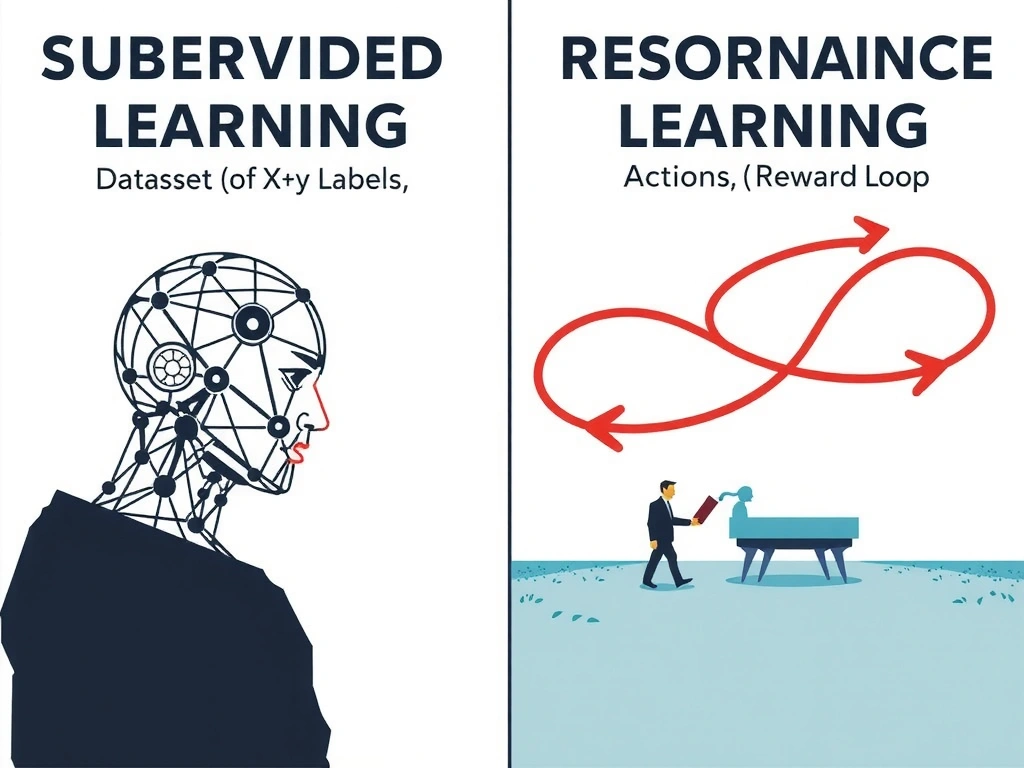
Let's make this sticky. Supervised learning is like studying with an answer key—every example has the right label. Reinforcement learning is like learning basketball by playing: you take actions, the environment responds, and rewards (or fouls) shape what you do next. No giant labeled spreadsheet required—just a goal signal over time. Compute cost? Either can be cheap or brutal. Task types? Supervised does class and regression; RL is about policies and decisions. And no, supervised is not a flavor of unsupervised. Exam trap: sorting paradigms by buzzwords instead of the feedback signal. Labels versus rewards—that's the contrast. You've got this.
Full explanation below image
Full Explanation
Machine learning paradigms differ chiefly in the feedback available during training. In supervised learning, each training instance pairs an input with a target label or value provided by an external supervisor. The learning algorithm minimizes a loss that compares predictions to those targets, producing models for classification, regression, or structured prediction. In reinforcement learning (RL), an agent interacts with an environment over time: it observes states, selects actions, and receives scalar rewards. The objective is to learn a policy that maximizes expected cumulative reward, often under delayed credit assignment and exploration–exploitation trade-offs.
That labeled-data versus reward-driven-decision distinction is the correct contrast. Computational expense is not definitional; large supervised deep models and large-scale RL (for example game agents or robotics) can both demand substantial resources. Task-type stereotypes also fail: supervised learning is not limited to regression, and RL is not a classification algorithm in the usual static sense—though classification-like decisions may appear as action choices. Finally, supervised learning is not a subset of unsupervised learning; unsupervised methods discover structure without target labels, forming a separate branch alongside supervised and RL (with semi-supervised and self-supervised variants filling intermediate niches).
Practically, choose supervised learning when historical input–output pairs exist and the deployment task is prediction. Choose RL when the problem is sequential control—bidding strategies, adaptive routing, game play, or robotic control—and you can specify rewards and a simulator or real environment. Memory aid: supervised = learn from answers; unsupervised = learn from structure; RL = learn from consequences. Keeping the feedback model clear prevents exam errors and mismatched system designs.