
A bank deploys a support chatbot that answers only from a fixed policy script and canned responses for account FAQs. It cannot learn arbitrary new tasks outside that scope. Which category of AI does this system represent?
Select an answer to reveal the explanation.
Short Explanation and Infographic
Here's the deal: almost every AI you touch at work is narrow AI—also called weak AI. It's great at one job, or a tight family of jobs, and useless outside that lane. A bank chatbot stuck to rules and canned answers? Classic narrow AI. Think of it like a calculator: fantastic at math, not going to write your strategy deck. AGI would flex across domains like a person. ASI is sci-fi super-human smarts. "Hybrid" sounds fancy but isn't what this scenario is testing. Exam trap: hearing "chatbot" and jumping to AGI. Nope—scope-limited systems are weak/narrow AI. Got it? Sweet.
Full explanation below image
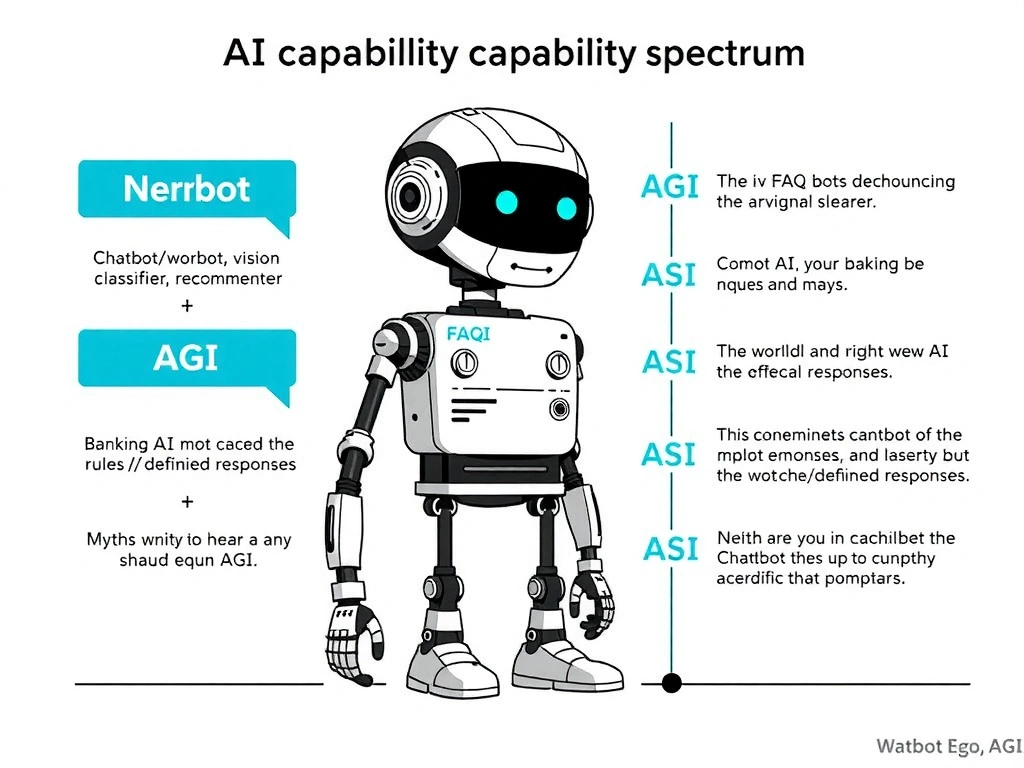
Full Explanation
AI systems are commonly categorized by the breadth of competence they exhibit. Weak AI, also called narrow AI, refers to systems engineered to perform one or a small set of well-defined tasks—spam filtering, recommendation ranking, optical character recognition, or a customer-support bot constrained to scripted banking FAQs. These systems can be highly effective within their envelope yet fail when asked to transfer skills to unrelated problems without substantial redesign.
The banking chatbot described—driven by rules and predefined responses—fits narrow AI: its behavior is bounded by policy content and engineered flows rather than open-ended understanding of the world. Artificial General Intelligence (AGI) denotes hypothetical or research-stage systems that could learn and reason across diverse domains at a level comparable to humans. Artificial Superintelligence (ASI) goes further, imagining performance that exceeds humans across most economically valuable tasks. Neither AGI nor ASI describes a production FAQ bot. "Hybrid AI" sometimes refers to architectures that combine symbolic and statistical components, but that engineering style is orthogonal to the weak/strong/general taxonomy and is not the best label for this scenario.
For practitioners and exam takers, the takeaway is to classify systems by capability scope, not by marketing language. A rules engine, a fine-tuned classifier, and even a large language model wrapped with tight retrieval and guardrails for one workflow are still typically framed as narrow AI in certification contexts. Governance, testing, and risk assessment should match that narrow scope: validate the covered intents, handle out-of-scope queries safely, and avoid implying general intelligence to users or regulators.