
When the business cost of missing a positive case (false negative) is especially severe, which evaluation priority is most appropriate, and which application best illustrates that need?
Select an answer to reveal the explanation.
Short Explanation and Infographic
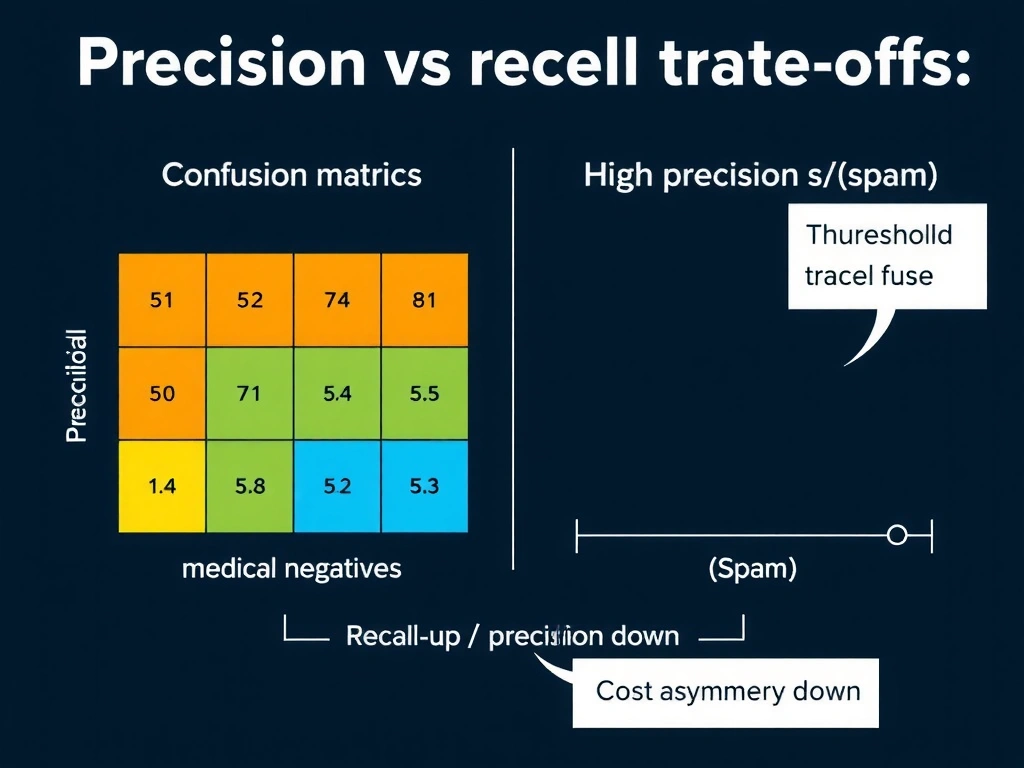
Let's talk recall—the "did we catch the real positives?" metric. If your boss walks in and says missing a sick patient is unacceptable, you crank recall up, even if you get more false alarms for doctors to review. Medical screening for a serious illness is the classic story. Spam filters? Different game—you hate burying real email, so precision often matters more. Movie recs and search ranking? Not life-or-death false negatives. Exam trap: mixing precision and recall. Precision is "when we say yes, are we right?" Recall is "of all the real yeses, how many did we find?" High false-negative cost → high recall. Trust me on this one—it'll show up on the test and in real systems.
Full explanation below image
Full Explanation
Classification metrics answer different operational questions. Precision asks: of the instances predicted positive, how many were truly positive? Recall (sensitivity) asks: of all actual positives, how many did the model detect? When a false negative is extremely costly—failing to flag a patient with a serious illness, missing a critical safety defect, or overlooking fraud that leads to major loss—stakeholders often require high recall so that few true positives slip through. Thresholds may be lowered, models calibrated, and human review queues sized to absorb extra false positives that accompany aggressive detection.
A medical diagnosis or screening model for a serious condition is the textbook illustration: the ethical and financial cost of a missed case typically outweighs the cost of additional confirmatory tests triggered by false positives. By contrast, a consumer spam filter often prioritizes precision (or a balanced F1) because routing legitimate mail to spam is highly visible and disruptive, while occasional missed spam is tolerable. Movie recommendation systems optimize ranking quality, diversity, and engagement rather than exhaustive detection of a rare critical class. General web search ranking similarly focuses on relevance and user satisfaction metrics, not on medical-style false-negative cost structures.
Best practice is to align the metric—and the decision threshold—with asymmetric costs, then report complementary metrics (precision, recall, F1, ROC-AUC, PR-AUC) so trade-offs are transparent. Memory aid: high cost of missed positives → protect recall; high cost of false alarms → protect precision. Always verify on realistic prevalence data, because class imbalance can make accuracy misleading even when recall is the true business priority.