
Why do practitioners commonly wrap preprocessing steps and an estimator in a scikit-learn Pipeline object?
Select an answer to reveal the explanation.
Short Explanation and Infographic
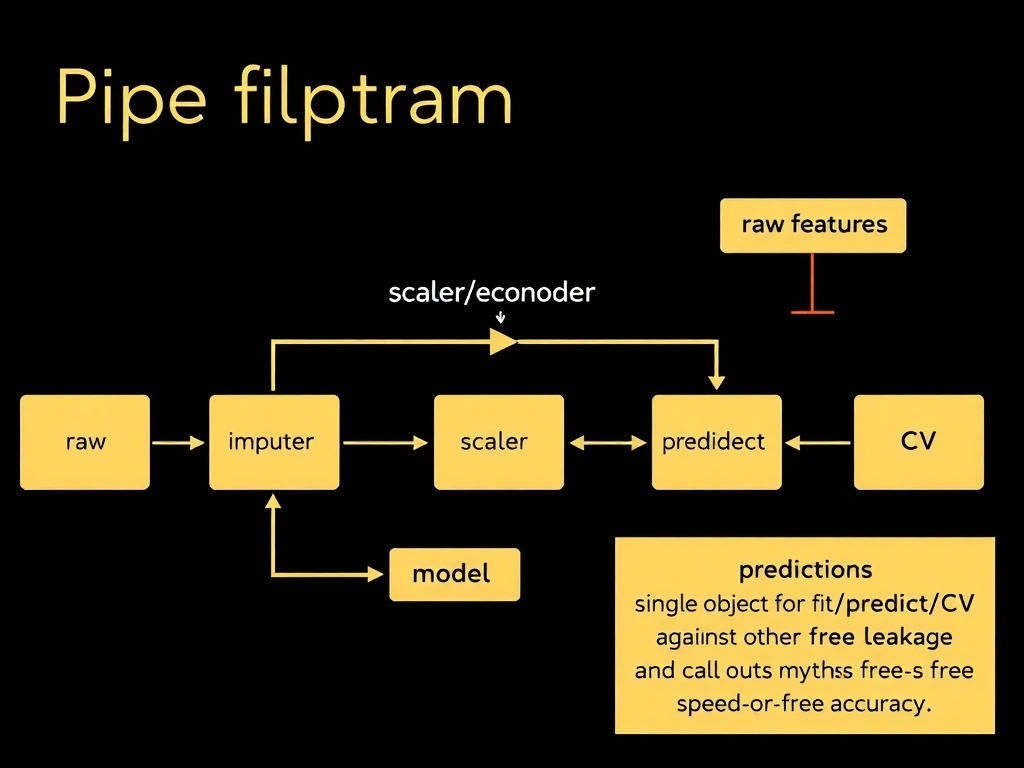
Okay, real talk: pipelines are about not shooting yourself in the foot. You glue scalers, encoders, and the model into one object so train and serve run the same recipe every time. Cross-validation stays honest—no peeking at the whole dataset before the split. Think of it like a factory assembly line: station one, station two, final product—no missing steps on the night shift. It doesn't make training magically cheaper, pick the best algorithm for you, or guarantee better accuracy. Exam trap: confusing "cleaner, safer workflow" with "automatically better model." Package the process; you still own the modeling decisions. Let's keep rolling.
Full explanation below image
Full Explanation
In scikit-learn and similar libraries, a Pipeline sequences one or more transformer steps followed by a final estimator. Calling fit on the pipeline fits each transformer on the training fold and then fits the model on the transformed data; predict applies the same transformations before scoring. This design yields several practical benefits: a single object to cross-validate, tune with grid or random search, serialize with joblib, and deploy; consistent ordering of steps between experimentation and production; and reduced risk of data leakage from fitting scalers or imputers on the full dataset before splitting. Without a pipeline, engineers often fit a scaler on the full matrix, then split—quietly letting test information influence training preprocessing.
Those workflow and correctness advantages are the main reason teams adopt pipelines—not promises of free speedups or automatic accuracy gains. Computational cost is dominated by the algorithms and data size you choose; the pipeline is orchestration rather than a faster optimizer. Automatic standardization and algorithm selection require explicit transformers and model-selection wrappers; a bare pipeline does not invent them. Accuracy still depends on features, labels, model class, and hyperparameters. In other words, packaging does not replace modeling judgment; it makes correct modeling habits easier to apply repeatedly.
Best practices include keeping all target-aware or distribution-fitting transforms inside the pipeline so they refit per cross-validation fold, naming steps clearly for inspection, and combining pipelines with ColumnTransformer when numeric and categorical columns need different treatment. Persist the entire fitted pipeline as the production artifact so inference cannot drift from training transforms. When tuning, search hyperparameters on the pipeline as a whole so every candidate configuration is evaluated under identical preprocessing. Memory aid: Pipeline equals one sealed workflow for transform-plus-model, optimized for hygiene and reuse in MLOps—not a substitute for thoughtful modeling or a guarantee of higher scores.