
In terms of how training data is used, what primarily distinguishes semi-supervised learning from standard supervised learning?
Select an answer to reveal the explanation.
Short Explanation and Infographic
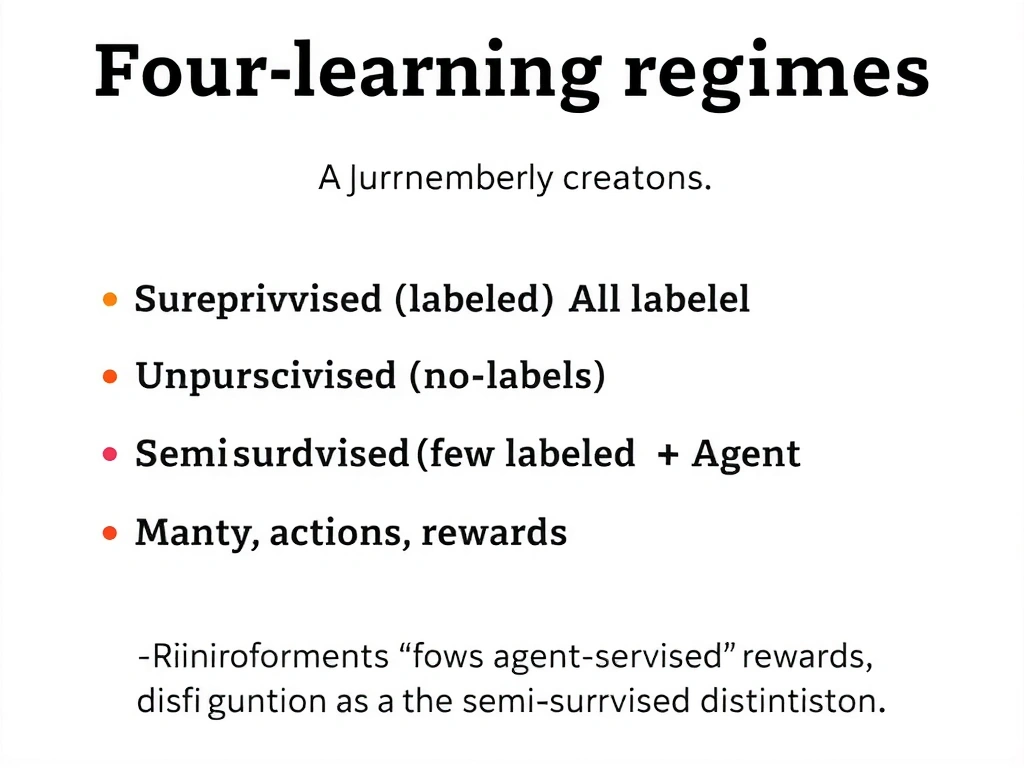
Check this out—labels are expensive. Supervised learning wants a label on every row: input X, answer Y. Semi-supervised says, "I've got a few labeled examples and a pile of unlabeled ones—let's use both." That's the whole split. Think of it like studying with a few answered practice tests plus a stack of unanswered ones to spot patterns. It's not reinforcement learning (that's rewards and actions). It's not automatically "cheaper compute." And it's not "just clustering." Exam trap: people mash semi-supervised together with unsupervised or RL. If the stem is about labeled-plus-unlabeled versus labeled-only, you've got it. Hopefully you nailed that—let's keep moving.
Full explanation below image
Full Explanation
Supervised learning trains a predictive model using examples that each include both inputs and ground-truth targets. Performance generally improves with more high-quality labels, but labeling is often costly—especially for medical images, legal text, or expert annotations. Semi-supervised learning addresses that bottleneck by assuming access to a relatively small labeled set together with a larger pool of unlabeled inputs drawn from a related distribution. Algorithms then exploit structure in the unlabeled data (for example cluster assumptions, low-density separation, consistency regularization, pseudo-labeling, or graph-based propagation) to improve generalization beyond what the labeled set alone would allow.
That data-usage difference is the primary distinction asked for here. It is not a claim that semi-supervised learning is a subtype of reinforcement learning; RL optimizes sequential decision-making via rewards, penalties, and exploration, which is a different learning paradigm. Computational cost is also not the defining criterion: semi-supervised training can be more expensive because models may process large unlabeled batches or multiple augmented views per example. Task type is likewise not the separator: while unsupervised clustering uses no labels, semi-supervised pipelines frequently solve classification or regression with partial labels rather than "only clustering."
In practice, teams choose semi-supervised approaches when unlabeled data is plentiful and labeling budgets are tight, then carefully validate that unlabeled examples match the deployment domain so pseudo-labels do not amplify bias. Memory aid: supervised = all labeled; unsupervised = no labels; semi-supervised = some labels + many unlabeled; reinforcement = learn by reward. Keeping those four regimes straight prevents common exam confusions and guides correct method selection on real projects.