
An organization trains a classifier to flag spam email. Over months, attackers invent new phrasing and tactics, so yesterday’s definition of spam no longer matches today’s inbox. What is the primary labeling challenge this creates for the training set?
Select an answer to reveal the explanation.
Short Explanation and Infographic
Here's the deal with spam models: the bad guys don't sit still. What counted as spam last quarter might look totally different this week—new scams, new subject lines, new tricks. So your labels age out. Think of it like a dress code that keeps changing; the old checklist stops working. That's concept drift, and it means you relabel, retrain, and monitor—not just collect a mountain of mail once and call it done. Volume is annoying but manageable. "Data never updates" is backwards. And algorithms for spam? Plenty of them. Exam trap: confusing "lots of data is hard" with "the definition of the target moves." For spam, the moving target is the story. Pay close attention—this bites production filters all the time.
Full explanation below image
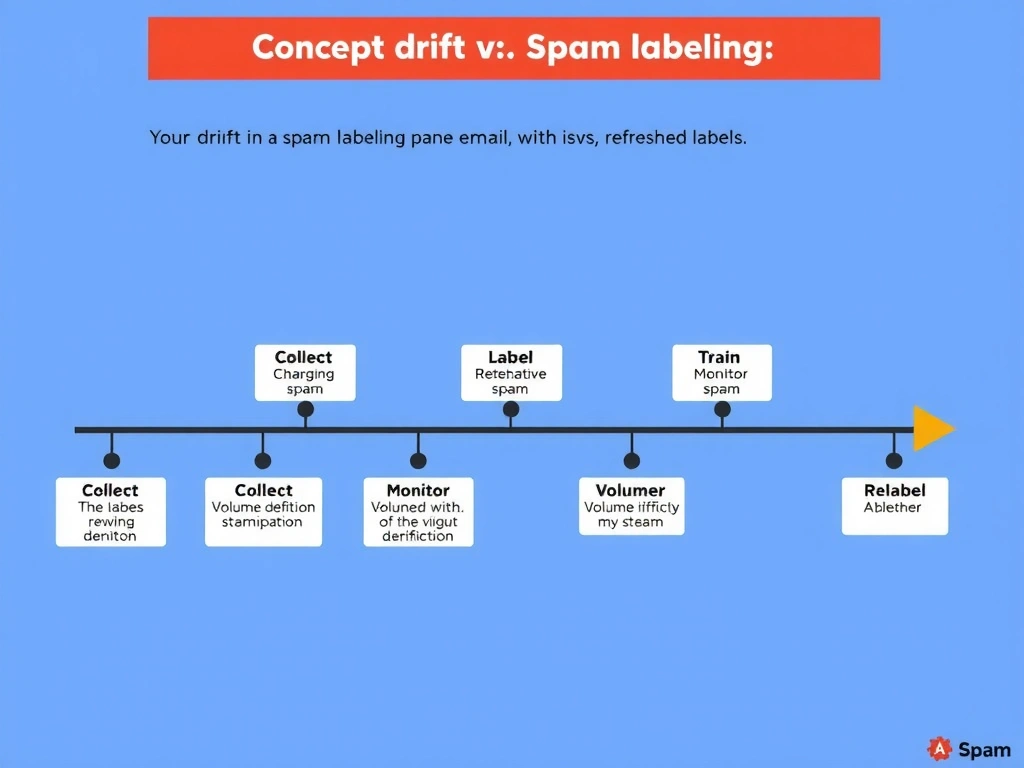
Full Explanation
Spam detection is a classic supervised classification problem, but the semantic meaning of the positive class is non-stationary. Attackers adapt language, infrastructure, and social-engineering patterns; user expectations and regulatory definitions of unwanted mail also shift. When the relationship between input features and the true label changes over time, practitioners call this concept drift (or, relatedly, data drift when the input distribution shifts). As a result, a carefully labeled corpus from last year can silently degrade model quality even if pipelines and algorithms remain correct.
Therefore the main challenge in collecting and labeling training data is not merely scale; it is sustaining a labeling process that tracks an evolving concept. Teams typically combine periodic human review, active learning to prioritize uncertain or novel messages, feedback loops from user "report spam" and "not spam" actions, and scheduled retraining or continuous learning policies. Monitoring precision, recall, and slice-level performance over time becomes as important as the initial dataset build.
Saying volume alone makes labeling impossible overstates the case: sampling strategies, weak supervision, and semi-automated queues make large corpora tractable. Claiming data rarely updates is factually wrong for adversarial domains like email abuse. Asserting that no suitable algorithm exists confuses data quality with model choice—logistic regression, gradient boosting, and neural text models have all been used successfully when labels stay current. Best practices include versioning label schemas, documenting labeling guidelines, measuring inter-annotator agreement, and treating spam filters as systems that require lifecycle management rather than one-shot training. On exams and in production, remember: for spam, freshness of labels and continuous adaptation are the decisive data challenges.