
In binary classification, which outcome is called a false positive?
Select an answer to reveal the explanation.
Short Explanation and Infographic
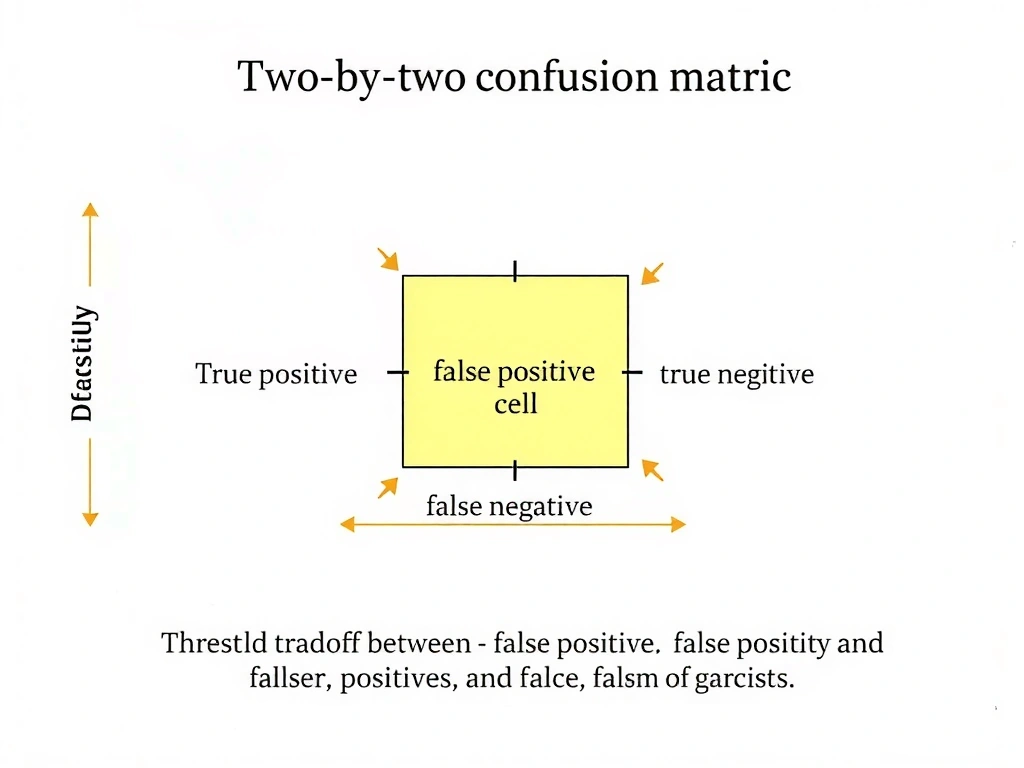
Let's make the confusion matrix personal. False positive means you rang the alarm when nothing was wrong—model said yes, reality said no. Spam filter dumping a clean email in junk? False positive. Missed fraud that slipped through? That's the other guy—false negative. True positive and true negative are the wins. Boss walks in asking why customers are angry about blocked cards? Often too many false positives at a tight threshold. Exam trap is swapping false positive and false negative under pressure. Memory aid: false positive equals falsely accused as positive. Get that straight and precision, recall, and F1 suddenly make sense. Keep going—you've got it.
Full explanation below image
Full Explanation
Binary classifiers map each instance to a predicted positive or negative label according to a decision rule. Comparing predictions to ground truth yields four exhaustive outcomes that completely fill a two-by-two confusion matrix. A true positive occurs when both prediction and label are positive. A true negative occurs when both prediction and label are negative. A false positive occurs when the prediction is positive but the label is negative, which is an erroneous alarm that claims a condition is present when it is not. A false negative occurs when the prediction is negative but the label is positive, which is a miss that fails to detect a real condition. These counts underpin precision, recall, specificity, F1, and many operating-point analyses used in applied machine learning evaluation work.
False positives matter differently by domain and product risk profile. In medical or credit screening, excess false positives drive unnecessary follow-up cost, user friction, and lost trust with customers or patients. In content moderation, they can suppress legitimate speech or block valid transactions that should have been allowed. Threshold choice on a score-based model trades false positives against false negatives in a predictable way. Raising the bar for calling a case positive usually reduces false positives while increasing false negatives. Precision focuses on purity among predicted positives and is hurt directly by false positives. Recall focuses on coverage of actual positives and is hurt by false negatives instead of false positives.
Learners often invert false positives and false negatives when reading quickly, especially under exam stress with similar wording. Anchor the language carefully every time. The word false means the prediction is wrong relative to ground truth. The following word names the class the model claimed in its output. Therefore a false positive means the model claimed the positive class incorrectly when the true class was negative. Do not confuse either error type with the correct outcomes known as true positives and true negatives. When reporting results, always state the positive class definition clearly, such as fraud, disease present, or loan default, because swapping that definition also swaps how you interpret false positives and false negatives in dashboards. Mastering this vocabulary is foundational for every later metric discussion in classification evaluation and for communicating model risk clearly to non-technical stakeholders who fund the work.