
What does the field of computer vision focus on within artificial intelligence?
Select an answer to reveal the explanation.
Short Explanation and Infographic
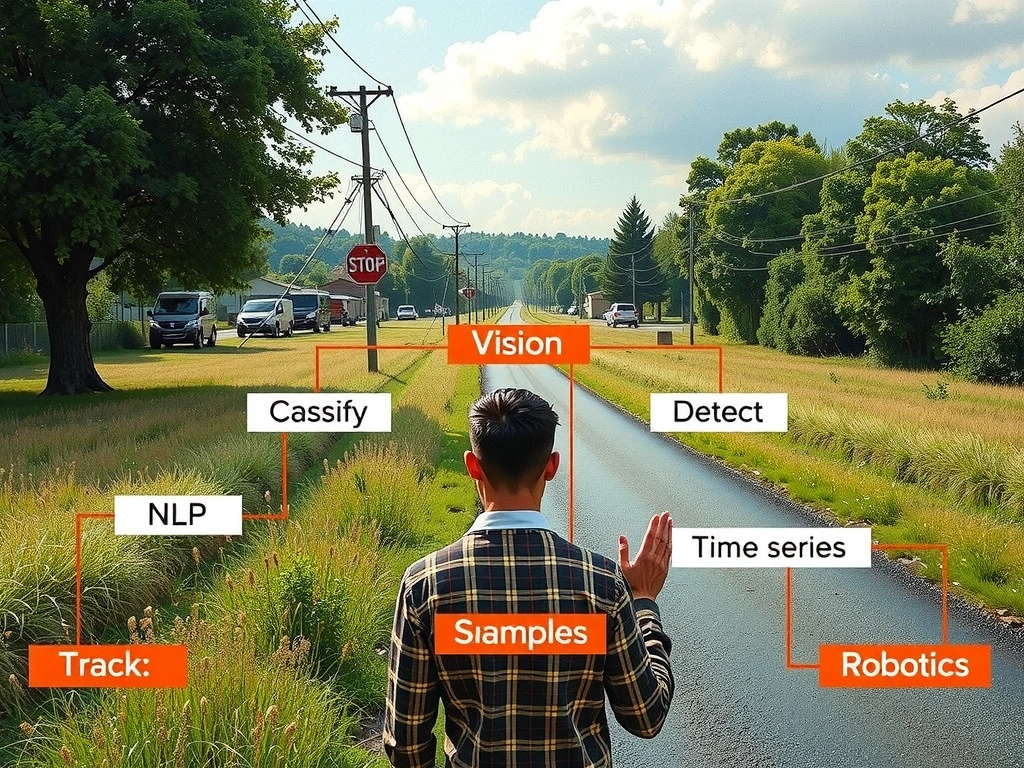
Plain English: computer vision is how software "sees." Cameras dump pixels; CV turns them into "that's a stop sign," "defect on the left edge," "person crossing." Imagine a warehouse boss who wants packages counted from overhead cameras by Monday—vision models, not a text chatbot, solve that. Time series? Different game. Text analytics? NLP's house. Robotics? Neighbor that often consumes vision but isn't the same field. Exam trap: mixing the big AI umbrellas. Land this: vision = interpret images/video. If there's no visual signal in the story, it's probably not CV. Keep that boundary crisp and these definition questions get easy.
Full explanation below image
Full Explanation
Computer vision is the AI discipline concerned with deriving usable understanding from visual media—still images, video frames, depth maps, and related sensor grids. Core problem families include image classification, object detection, semantic and instance segmentation, pose estimation, optical flow, three-dimensional reconstruction, and visual tracking. Modern systems often use convolutional networks or vision transformers trained on large labeled or multimodal datasets, but the field’s identity is the visual perception goal, not one architecture brand.
Distractors map to adjacent domains. Sequential non-visual forecasting belongs to time-series and forecasting methods; financial tick models without images are not computer vision. Language understanding is natural language processing. Robotics integrates perception, planning, and control; vision can supply perception modules, yet equating computer vision with robotics and physical actuation confuses a sensing and interpretation specialty with embodied action. Multimodal products blur edges in the market, but exam definitions still separate vision, language, and control.
Applications span manufacturing inspection, medical imaging, autonomous navigation perception, retail analytics, and content moderation for images and video. Success depends on data quality, labeling standards, robustness to lighting and domain shift, and latency constraints on device or server.
Underlying principle: match the modality. Pixels and video imply computer vision; tokens and text imply NLP; actions and joints imply robotics; pure timestamps imply time series. Best practice defines the visual task precisely (classify versus detect versus segment) and evaluates with metrics suited to that task. Memory aid: when a question asks what computer vision is, choose interpreting visual data. If there is no visual signal in the story, it is probably not computer vision.