
Which statement best describes the transformer architecture in modern AI systems?
Select an answer to reveal the explanation.
Short Explanation and Infographic
Check this out—transformers ditched the old "read the sentence one word at a time" bottleneck. Self-attention lets every token look at every other token and decide what matters. "The animal didn't cross the street because it was tired"—attention figures out what "it" refers to. That's why your chat models and modern NLP stacks feel so fluent. Boss says ship a summarizer by next quarter—you're living in transformer land. Trap: exam options will wave clustering, "only for images," or "only for making pictures" at you. Nope. Core idea: attention over sequences, huge in NLP/LLMs (and now elsewhere). Got it? Sweet. When you see attention + sequences, think transformer.
Full explanation below image
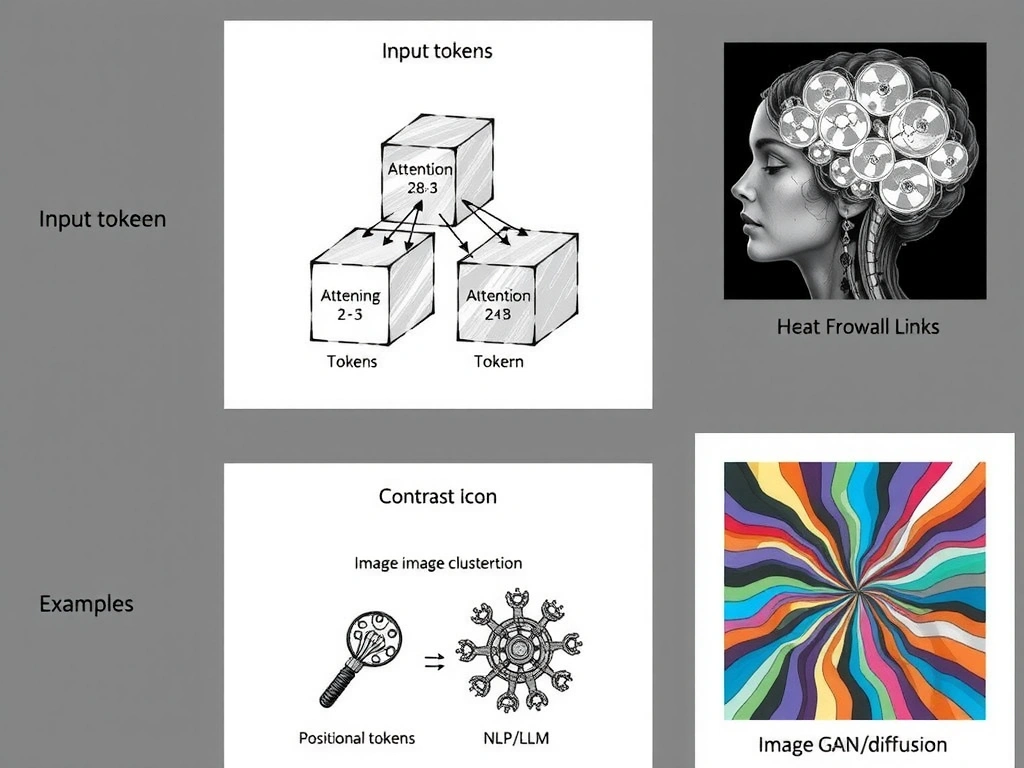
Full Explanation
The transformer architecture, introduced for machine translation, processes sequences primarily through multi-head self-attention and position-wise feed-forward layers rather than recurrence. Self-attention computes weighted interactions among all positions in a sequence (with positional encodings supplying order information), allowing the model to capture long-range dependencies and to train with high parallelism on modern hardware. Encoder-only, decoder-only, and encoder-decoder variants underpin contextual language models and generative large language models; the same attention idea later expanded into vision transformers and multimodal systems.
The correct option states this attention-centric sequence modeling role, especially in NLP. Clustering algorithms address unsupervised grouping of static feature vectors without defining a transformer. Framing transformers as "the" classic image-classification model erases their NLP origin and overstates historical CNN dominance in vision classification—even though ViTs are important today. Restricting them to image generation confuses transformers with GAN/diffusion image synthesizers; transformers can generate images in some systems, but that is not their defining textbook identity.
Underlying principle: attention provides a flexible dependency model over sequences without requiring recurrence. Best practice matches encoder, decoder, or encoder–decoder variants to the task, watches context-length and compute cost, and evaluates generation quality with both automatic metrics and human review. Memory aid: transformer equals attention over tokens or sequences; LLM families are transformer-based. On multiple-choice items, prefer answers that mention attention and sequential or token data over generic clustering or purely visual generative labels. In practice, document the decision criteria you used so teammates can reproduce the evaluation. Prefer metrics and checks that match the business risk, not vanity scores. When reviewing distractors on an exam item, name the misconception each option encodes: wrong learning paradigm, wrong evaluation stage, or a metric that optimizes the wrong objective. A reliable memory aid is to restate the concept in one sentence, then ask which option alone matches that definition without adding unrelated goals. Finally, connect the idea to a production workflow step—data prep, training, validation, or monitoring—so the correct answer stays grounded in how systems are actually built and governed.