
Which of the following tasks is an example of unsupervised learning?
Select an answer to reveal the explanation.
Short Explanation and Infographic
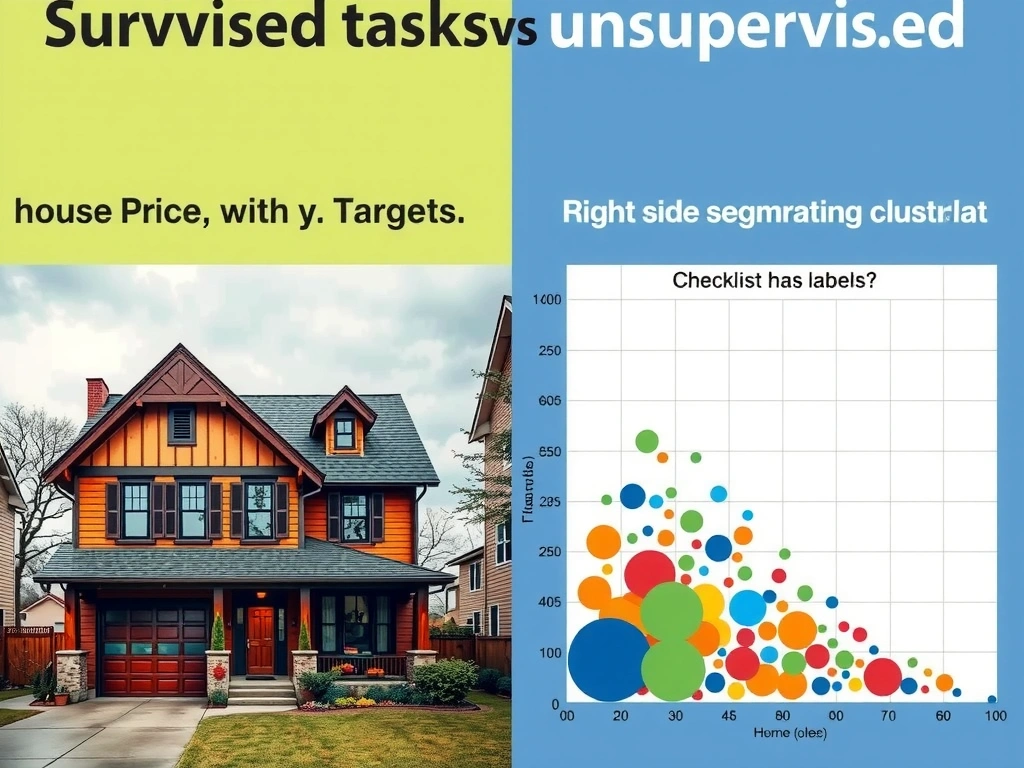
Here's the simple test I want you to use: do we have the "right answer" column for every row while we train? If yes, that's supervised. If no—we're just hunting patterns—that's unsupervised. Customer segmentation: marketing hands you purchase histories, no "segment A/B/C" labels—you discover the groups. House prices, spam flags, image class tags? Those come with targets. Boss walks in with a CRM dump and says "find natural buyer tribes"—unsupervised. Exam trap: every shiny business task sounds "smart"; look for whether labels exist. Land it: no labels → unsupervised (clustering, segmentation, some dimensionality reduction). Labels → supervised. You'll knock these out fast once that switch flips.
Full explanation below image
Full Explanation
Supervised learning trains on input-output pairs (x, y), learning a mapping that generalizes to new x. Classification (spam vs ham, image categories) and regression (house prices) are the textbook supervised families. Unsupervised learning receives only inputs x and seeks structure: clusters, density estimates, latent factors, or association patterns without target labels.
Customer segmentation groups users by similarity in features such as recency, frequency, monetary value, or demographics, typically via clustering (k-means, hierarchical, Gaussian mixtures) or related methods. No pre-assigned segment label is required for training—the groups emerge from the data—so the task is unsupervised. Image classification, house-price regression, and labeled spam detection each require ground-truth outputs during training and are therefore supervised.
Related nuances: semi-supervised learning mixes few labels with many unlabeled points; reinforcement learning optimizes sequential decisions via rewards rather than static labels. Exams usually stay binary: labeled prediction versus structure discovery. Underlying principle: unsupervised tasks discover structure without target labels; supervised tasks learn from labeled targets. Best practice confirms whether historical rows include the answer key before choosing methods and metrics. Memory aid: if the business already has the answer key for historical rows, think supervised; if the goal is find natural groups or compress patterns, think unsupervised. Customer segmentation is the canonical unsupervised business example opposite spam, price, and labeled image tasks. In practice, document the decision criteria you used so teammates can reproduce the evaluation. Prefer metrics and checks that match the business risk, not vanity scores. When reviewing distractors on an exam item, name the misconception each option encodes: wrong learning paradigm, wrong evaluation stage, or a metric that optimizes the wrong objective. A reliable memory aid is to restate the concept in one sentence, then ask which option alone matches that definition without adding unrelated goals. Finally, connect the idea to a production workflow step—data prep, training, validation, or monitoring—so the correct answer stays grounded in how systems are actually built and governed.