
In data preprocessing, what is the main purpose of normalizing continuous features?
Select an answer to reveal the explanation.
Short Explanation and Infographic
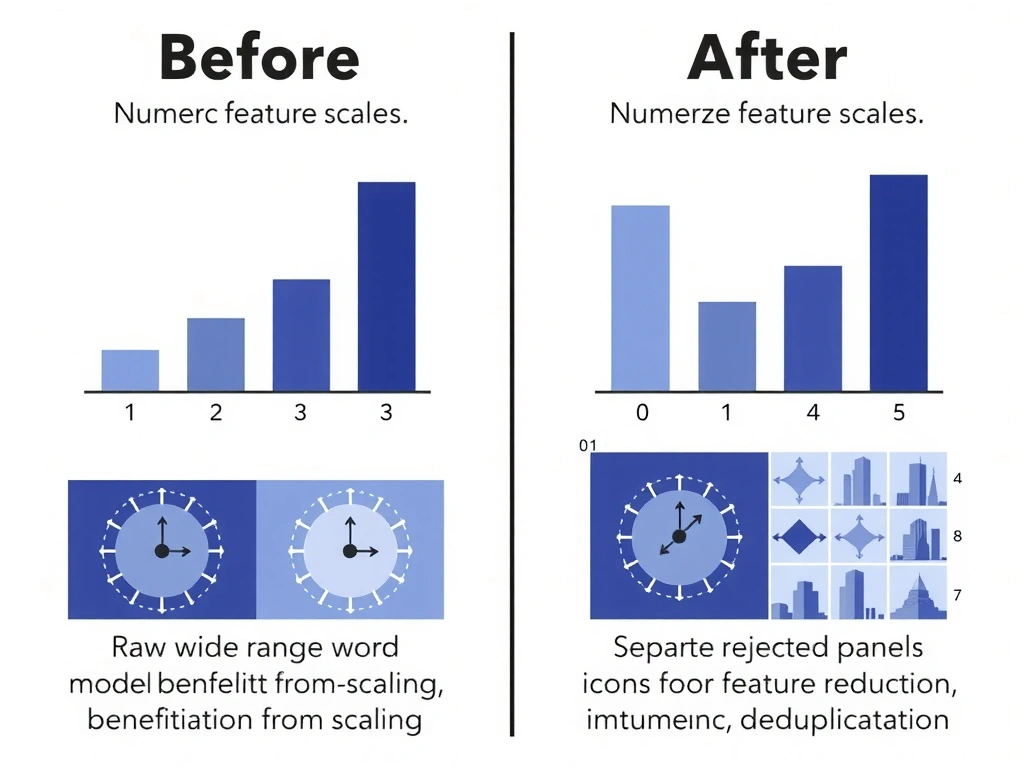
Here's where it gets interesting for you. One feature is "income" in tens of thousands; another is "age" from 18 to 90. Without scaling, the big-number column bullies the little one—especially in k-NN, SVM, neural nets, you name it. Normalization squishes those numbers into a shared neighborhood, often 0 to 1, so the model isn't distracted by raw units. Think of it like converting every currency to the same dollar before comparing prices. Exam trap: folks confuse normalize with "drop features," "fill missing," or "delete duplicates." Those are cleanup cousins, different tools. Land the takeaway: normalization = rescale continuous values for fair, stable learning. You'll thank yourself when the optimizer stops acting weird.
Full explanation below image
Full Explanation
Continuous features often arrive in incompatible units and magnitudes. Algorithms that rely on distances, regularization penalties, or gradient steps can become dominated by large-scale variables or suffer slow, ill-conditioned optimization. Normalization typically maps each feature into a fixed interval—most commonly min-max scaling to [0, 1] or another chosen range—using training-set statistics applied consistently to validation and test data. Related practice, standardization (z-score), centers and scales by mean and standard deviation; exams often group both under "scaling," but the question's classic definition of normalization emphasizes range-bounded rescaling to improve model behavior.
The correct answer captures that purpose. Reducing the number of features is selection or projection (PCA, autoencoders, filter methods). Filling missing values is imputation. Removing duplicate records is deduplication. None of those change the geometric scale of a retained numeric column the way normalization does.
Best practices: fit scalers only on training folds to avoid leakage; choose scaling method based on outlier sensitivity (min-max is outlier-sensitive; robust scalers use percentiles); reverse-transform when you need human-readable predictions on the original scale. Underlying principle: rescaling continuous inputs levels the playing field for distance- and gradient-based learners. Best practice fits scaler statistics on training data only and chooses a method robust to outliers when needed. Memory aid: normalization answers whether the numbers are playing on the same field—not which columns stay, what about NaNs, or whether rows are unique. In practice, document the decision criteria you used so teammates can reproduce the evaluation. Prefer metrics and checks that match the business risk, not vanity scores. When reviewing distractors on an exam item, name the misconception each option encodes: wrong learning paradigm, wrong evaluation stage, or a metric that optimizes the wrong objective. A reliable memory aid is to restate the concept in one sentence, then ask which option alone matches that definition without adding unrelated goals. Finally, connect the idea to a production workflow step—data prep, training, validation, or monitoring—so the correct answer stays grounded in how systems are actually built and governed.