
Why do practitioners commonly use cross-validation when assessing a supervised model?
Select an answer to reveal the explanation.
Short Explanation and Infographic
Let me show you how this works in the real world. One lucky train/test split can make a model look like a hero—or a disaster—just by chance. Cross-validation says, "Let's rotate the holdout and average the scores so nobody gets fooled by one draw of the cards." Think of it like tasting every slice of the pizza, not just the one with all the toppings. Boss walks in: "Is this accurate, or did we overfit last night's split?" CV is your honest answer. Trap: CV is not training, not a learning-rate finder by itself, and not data cleaning. Those are neighboring jobs. Takeaway: CV = robust performance estimate and overfitting reality check. When the exam says "more reliable evaluation," pick CV.
Full explanation below image
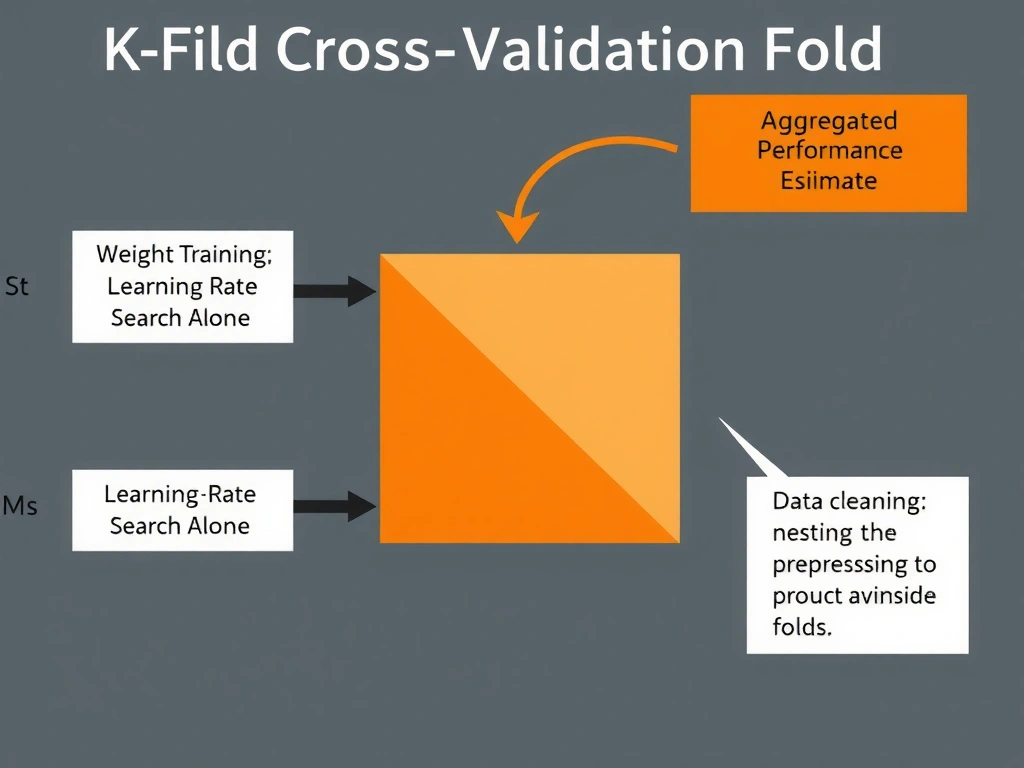
Full Explanation
A single train/validation partition can be noisy: the held-out slice might be unusually easy or hard, or hyperparameters may be tuned until that one slice looks perfect (selection bias / overfitting the validation set). Cross-validation mitigates this by systematically reusing the data. In k-fold CV, the dataset is split into k folds; each fold serves once as validation while the remaining folds train the model; metrics are aggregated (mean and often variance). Variants include stratified folds for classification, leave-one-out for tiny sets, and nested CV when both model selection and final performance estimation must stay honest.
Thus the purpose of CV is a more robust estimate of out-of-sample performance and a safeguard against over-interpreting one split—not parameter training, not automatic learning-rate discovery, and not preprocessing. Training optimizes weights via the loss and optimizer. Learning-rate search is hyperparameter optimization that consumes evaluation scores; CV supplies those scores but is not defined as "find the learning rate." Imputation, encoding, and cleaning prepare features; if performed on the full dataset outside the folds, they can leak information into validation scores—best practice nests preprocessing inside each training fold.
Underlying principle: CV averages performance across rotating held-out folds so one lucky split cannot dominate model selection. Best practice nests preprocessing inside folds and reserves a final test set when nested CV is impractical. Exam cue: associate cross-validation with evaluation integrity and generalization estimates. If an option describes fitting weights, tuning one specific hyperparameter as the definition, or scrubbing data, it misses the core purpose. In practice, document the decision criteria you used so teammates can reproduce the evaluation. Prefer metrics and checks that match the business risk, not vanity scores. When reviewing distractors on an exam item, name the misconception each option encodes: wrong learning paradigm, wrong evaluation stage, or a metric that optimizes the wrong objective. A reliable memory aid is to restate the concept in one sentence, then ask which option alone matches that definition without adding unrelated goals. Finally, connect the idea to a production workflow step—data prep, training, validation, or monitoring—so the correct answer stays grounded in how systems are actually built and governed.