
In binary classification metrics, what does the F1 score specifically measure?
Select an answer to reveal the explanation.
Short Explanation and Infographic
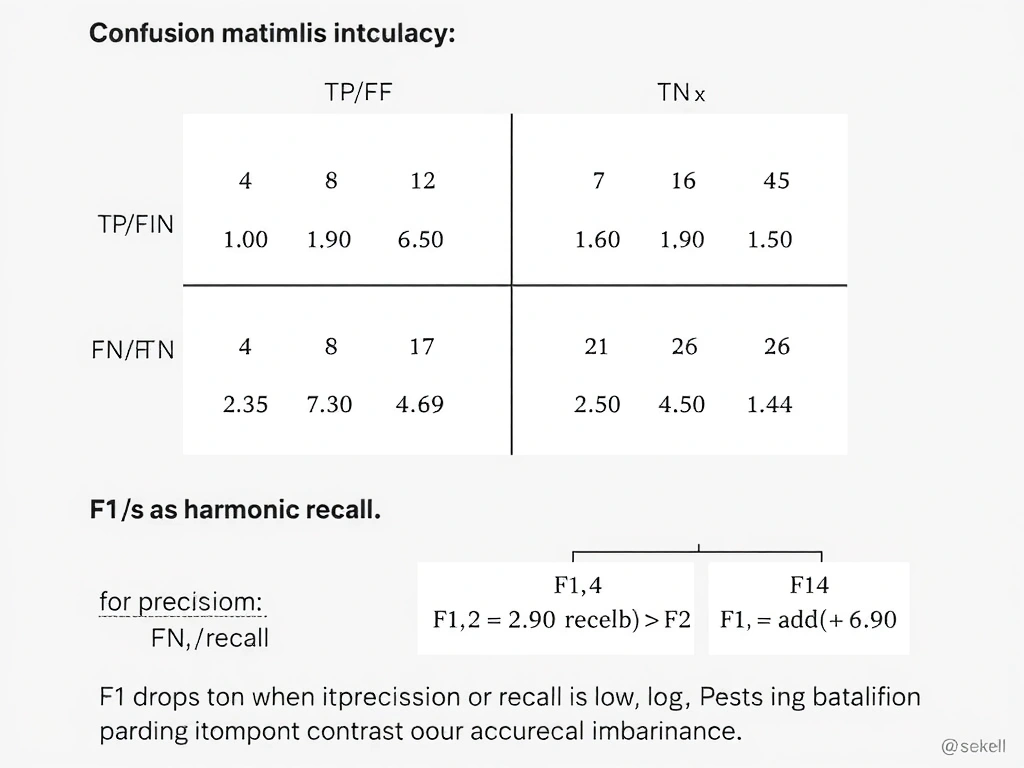
Check this out—precision says "when I yell spam, how often am I right?" Recall says "of all the real spam, how much did I catch?" You can ace one and tank the other. F1 is the peacemaker: harmonic mean of both, so one weak side drags the score down hard. Imagine your boss only cares about a single number on a dashboard after a skewed fraud dataset wrecked plain accuracy—F1 is what shows up. Trap alert: don't confuse F1 with precision, with "accuracy plus something," or with a raw correct-count. If the option doesn't marry precision and recall with a harmonic mean, it's not F1. Land it: F1 rewards balanced retrieval quality. Practice computing a tiny confusion matrix once and it'll stick.
Full explanation below image
Full Explanation
Classification evaluation separates different error types. Precision = TP / (TP + FP) answers how trustworthy positive predictions are. Recall = TP / (TP + FN) answers how completely positives are recovered. Accuracy = (TP + TN) / N can look excellent under class imbalance while missing the minority class almost entirely.
The F1 score combines precision and recall via their harmonic mean: F1 = 2PR / (P + R). The harmonic mean is more conservative than an arithmetic average: if either precision or recall approaches zero, F1 collapses toward zero. That property makes F1 a standard summary when both false positives and false negatives matter and classes may be uneven—spam filters, medical screening triage, information retrieval, and many certification examples.
The distractors encode common mix-ups. "Ratio of true positives to all positive predictions" is precision only. Averaging accuracy with precision is not a recognized definition of F1 and mixes metrics with different denominators and meanings. A total of correct predictions ignores the precision-recall trade-off and is closer to the numerator of accuracy. Related variants (macro/micro/weighted F1, F-beta) adjust class averaging or relative weight of recall versus precision, but the core idea remains a harmonic combination of precision and recall.
Underlying principle: F1 forces both precision and recall to be healthy via a harmonic mean, which is especially useful under imbalance. Best practice pairs F1 with a confusion matrix and chooses macro, micro, or weighted averages intentionally for multi-class problems. Memory aid: F1 is a both-must-be-healthy score. If an option mentions only one of precision or recall, accuracy, or raw counts, eliminate it.