
What is the primary role of a convolutional neural network (CNN) when applied to structured spatial inputs?
Select an answer to reveal the explanation.
Short Explanation and Infographic
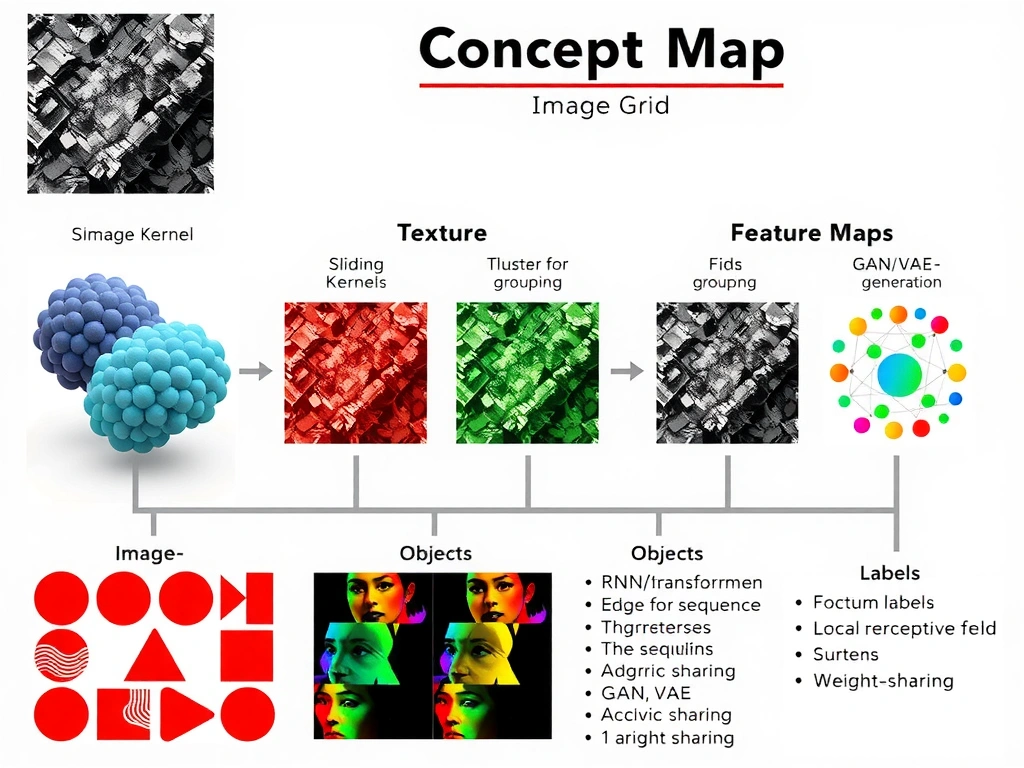
Here's the deal: a CNN is built for stuff that lives on a grid—pixels, patches, local neighborhoods. Think of it like a flashlight sliding across a photo. Each filter asks, "Is there an edge here? A corner? A texture?" Early layers catch simple patterns; deeper layers compose them into eyes, wheels, logos. Pretty cool, right? Your boss drops a folder of product photos and wants defects flagged by Friday—CNNs are why that works. Exam trap: people mash architectures together. Sequences? Think RNN/transformer first. Clustering? Different problem. "Make new pictures"? Generative models. Land this: CNN = local receptive fields + weight sharing on spatial grids. You've got this—next time you see "images" and "features," CNN should light up.
Full explanation below image
Full Explanation
Convolutional neural networks exploit spatial locality and translation equivariance. A convolutional layer applies small learnable kernels across spatial positions, producing feature maps that respond to local patterns. Pooling or striding then downsamples, expanding the effective receptive field so deeper layers capture larger structures. Parameter sharing means the same edge detector is reused everywhere, which is far more sample-efficient than a fully connected layer on flattened pixels.
That design matches grid-structured data—images, medical volumes, spectrograms treated as 2D maps, and similar tensors. Hence the correct answer: extract hierarchical features from grid data such as images. Modeling pure sequential dynamics is historically associated with recurrent networks and attention-based transformers (though temporal 1D convolutions exist as tools, they are not the textbook primary purpose of "a CNN"). Clustering algorithms (k-means, hierarchical clustering, Gaussian mixtures) assign groups without requiring convolutional inductive bias. Generative models learn to synthesize new samples; a plain CNN classifier or feature backbone does not, by itself, define a generative process.
Underlying principle: choose architecture by data structure and task. Grid plus local patterns points to convolution; sequence plus order points to recurrence or attention; unlabeled grouping points to clustering; synthesis points to generative models. Best practice still verifies that receptive fields, data augmentation, and evaluation metrics match the visual task. Exam questions often swap these roles; map each option back to the inductive bias it actually encodes. In practice, document the decision criteria you used so teammates can reproduce the evaluation. Prefer metrics and checks that match the business risk, not vanity scores. When reviewing distractors on an exam item, name the misconception each option encodes: wrong learning paradigm, wrong evaluation stage, or a metric that optimizes the wrong objective. A reliable memory aid is to restate the concept in one sentence, then ask which option alone matches that definition without adding unrelated goals. Finally, connect the idea to a production workflow step—data prep, training, validation, or monitoring—so the correct answer stays grounded in how systems are actually built and governed.