
What does feature engineering primarily involve in a machine learning workflow?
Select an answer to reveal the explanation.
Short Explanation and Infographic
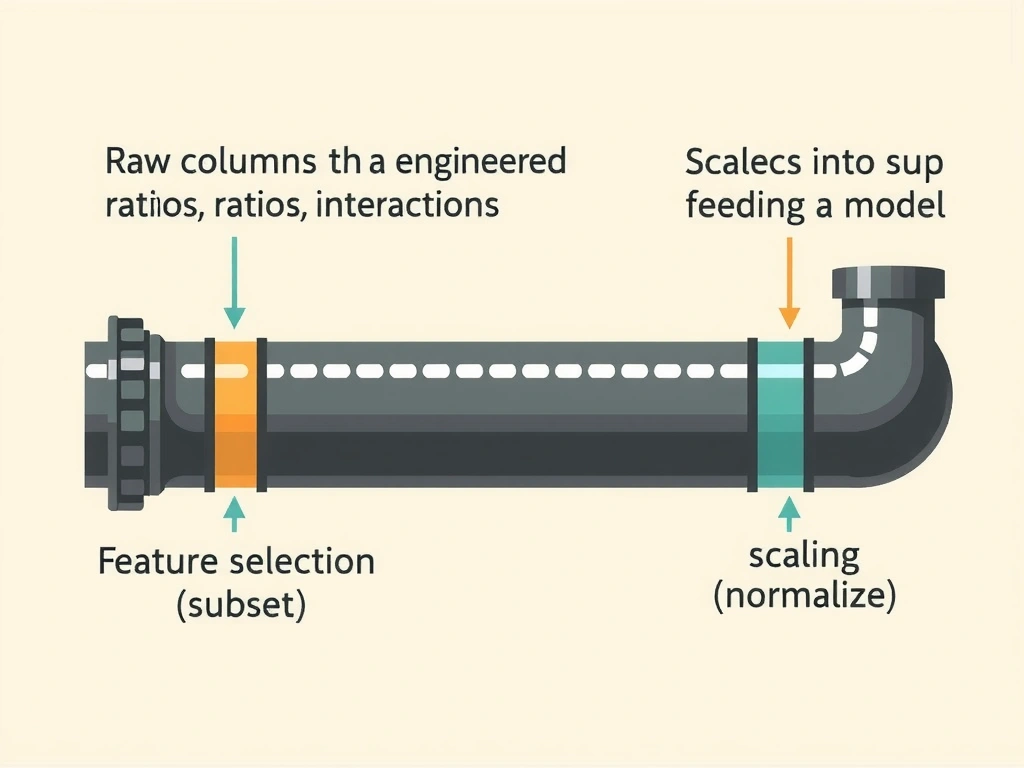
Here's the deal: models are only as smart as the signals you feed them. Feature engineering is when you invent better signals—ratios of week from timestamps, price-per-square-foot from price and size, TF–IDF from text—so the model stops fighting the raw mess. Think of it like prepping ingredients before cooking; the chef (the algorithm) still matters, but chopped and seasoned food cooks better. Exam trap: calling pure feature selection or pure normalization "feature engineering." Selection trims; scaling rescales; engineering creates. You'll see all three in real pipelines—just don't mix the definitions on test day. Get hands-on and craft a few features yourself; it sticks.
Full explanation below image
Full Explanation
Feature engineering is the practice of transforming raw data into predictive inputs that better expose structure to a learning algorithm. Examples include interaction terms, polynomial expansions, aggregations such as customer lifetime totals, time-based features such as hour or seasonality, domain formulas, binning, and text or graph-derived attributes. Good features often matter as much as model choice, especially for classical machine learning on tabular data. The engineer’s domain knowledge becomes numerical signal the model can use.
Feature selection removes or ranks existing variables to reduce noise and dimensionality; it is complementary but not identical to creating new predictors. Scaling and normalization adjust magnitudes for algorithms sensitive to feature scale; they do not create new semantic information. Simply deleting useless columns is a limited form of selection, not the full scope of engineering new predictors. Exam options that say only delete, only rank, or only rescale therefore miss the constructive core of feature engineering.
In deep learning, models sometimes learn representations automatically, yet tabular and production systems still rely heavily on human or automated feature construction. Automated feature tools and embeddings can help, but understanding ratios, windows, and domain constraints remains valuable. Always fit transformations on training data only to avoid leakage into validation and test sets.
Underlying principle: better inputs often beat marginal algorithm tweaks. Best practice iterates features with validation metrics, documents formulas, and guards against leakage from future information. Memory aid: engineer means build new levers; select means choose among levers; scale means resize levers. When the stem emphasizes designing and constructing new input variables, choose feature engineering.