
In machine learning models, what is a latent variable?
Select an answer to reveal the explanation.
Short Explanation and Infographic
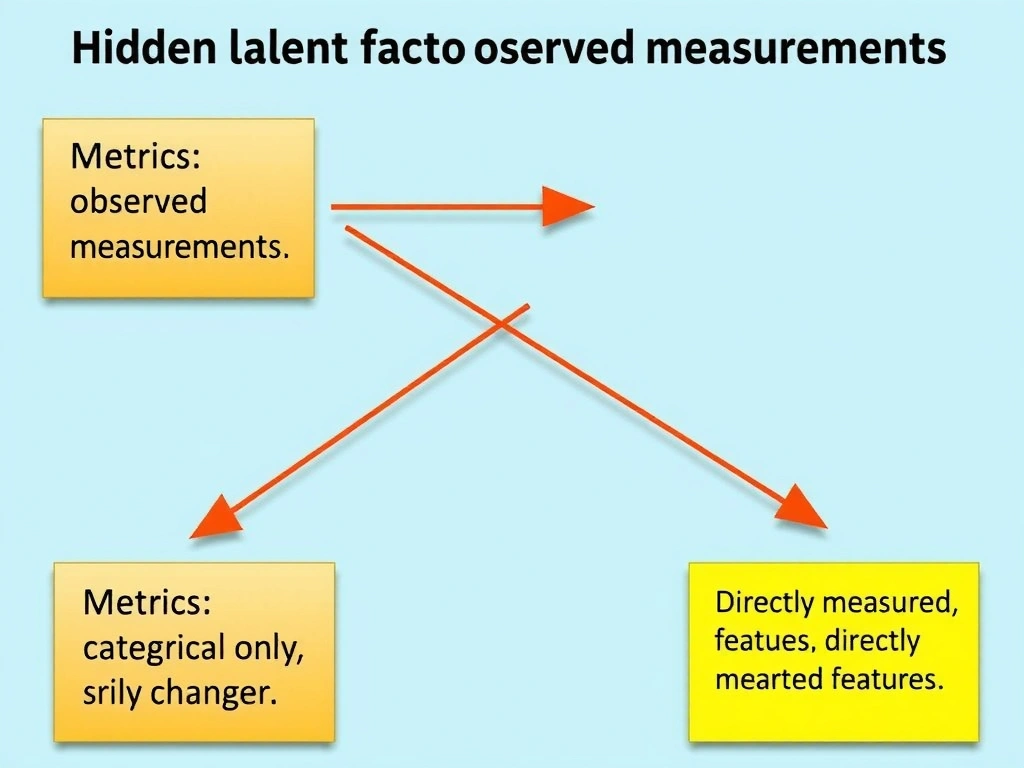
Pay close attention—"latent" just means hidden. You see height, income, clicks… but maybe an unobserved "customer intent" or "topic mix" is driving the patterns. That hidden driver is a latent variable. Think of it like explaining weather readings with an invisible front moving through: you measure temperature and pressure; you infer the front. Exam trap: calling accuracy a latent variable, or saying latent means "categorical," or confusing it with columns you already logged. If you can point to it in the CSV, it's observed—not latent. Models like factor analysis, topic models, and VAEs live on this idea. Got it? Hidden cause, observed effects.
Full explanation below image
Full Explanation
A latent variable is a quantity that is not directly observed in the data but is hypothesized or modeled as influencing observed variables. Examples include latent topics in document collections, personality factors in psychometrics, cluster membership in mixture models, and continuous latent codes in variational autoencoders. Inference recovers distributions or point estimates of these hidden factors from what was measured. The scientific and engineering value is explaining correlations among observations with a simpler hidden structure.
Performance metrics such as accuracy and F1 evaluate predictions; they are not latent data-generating factors. Discrete or categorical type is orthogonal: a latent class is discrete and hidden; a measured category is discrete and observed. Directly recorded dataset fields are observed variables—the contrast class to latent ones. If you can point to the column in the CSV as measured, it is observed, not latent.
Latent-variable modeling helps compress structure, denoise, and support generative stories about how data arise. Challenges include identifiability, choosing the number of latent dimensions, and validating that inferred factors are meaningful to domain experts. Methods range from classical factor analysis and LDA-style topic models to modern deep latent-variable models.
Underlying principle: some useful structure is hidden and must be inferred from measurements. Best practice states modeling assumptions clearly, checks sensitivity to the number of latent factors, and validates factors qualitatively when they drive decisions. Memory aid: latent means behind the curtain; observed means on the stage of your dataset. When the question defines an unobserved factor that influences measurable variables, the answer is a latent variable.