
In modern NLP and machine learning, what does a vector embedding represent?
Select an answer to reveal the explanation.
Short Explanation and Infographic
Okay, let's make embeddings click. Words aren't numbers—until we map them into a vector space where "king" sits nearer "queen" than "carburetor." That's the whole game: dense vectors that capture meaning so distance and direction mean something. Think of it like GPS coordinates for concepts. Exam trap: mixing embeddings with activation functions, with "just delete features," or with basic text cleaning. Those are different tools. When the question says vector embedding, answer semantic dense vectors. Pretty cool, right? Once you see nearest-neighbor search in embedding space, you'll never forget it.
Full explanation below image
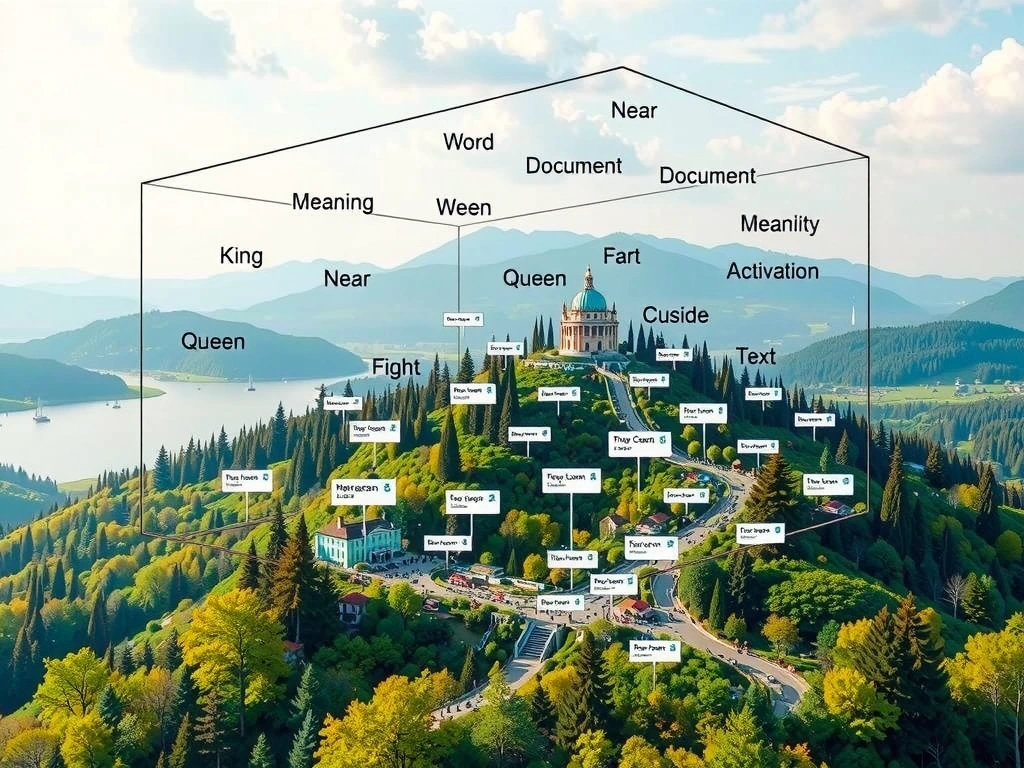
Full Explanation
A vector embedding is a mapping from discrete objects—words, sentences, users, products, graph nodes—into a continuous vector space of fixed dimension. Training or encoding arranges the space so semantic or behavioral similarity corresponds to geometric proximity, and sometimes to consistent relational directions. Classic word embeddings such as word2vec and GloVe, and modern contextual embeddings from transformers, underpin similarity search, clustering, classification features, retrieval-augmented generation, and multimodal alignment. Nearest neighbors in embedding space become a practical retrieval API.
Embeddings are not activation functions such as ReLU or sigmoid; those transform neuron pre-activations inside a network. They are not synonymous with generic dimensionality reduction, even though embedding dimensions are often much smaller than sparse one-hot vocabularies; the defining property is a meaningful dense representation, not merely fewer columns. They are not text-cleaning steps such as tokenization or stopword removal—those are preprocessing stages that may precede embedding lookup or encoding.
In systems design, embeddings enable semantic search, recommendations, and clustering when exact keyword match fails. Quality depends on training data, context window, and whether vectors are static or contextual. Dimensionality, normalization, and index structures (for example approximate nearest neighbor search) affect latency and recall in production.
Underlying principle: discrete symbols become points in a space where distance reflects meaning or behavior. Best practice evaluates retrieval relevance, monitors drift as language changes, and separates preprocessing from the embedding representation itself. Memory aid: embedding equals coordinates of meaning. Clean text first if needed, activate neurons inside the net, reduce dimensions when useful—but only the semantic vector mapping is the embedding itself.