
What is the defining idea behind federated learning?
Select an answer to reveal the explanation.
Short Explanation and Infographic
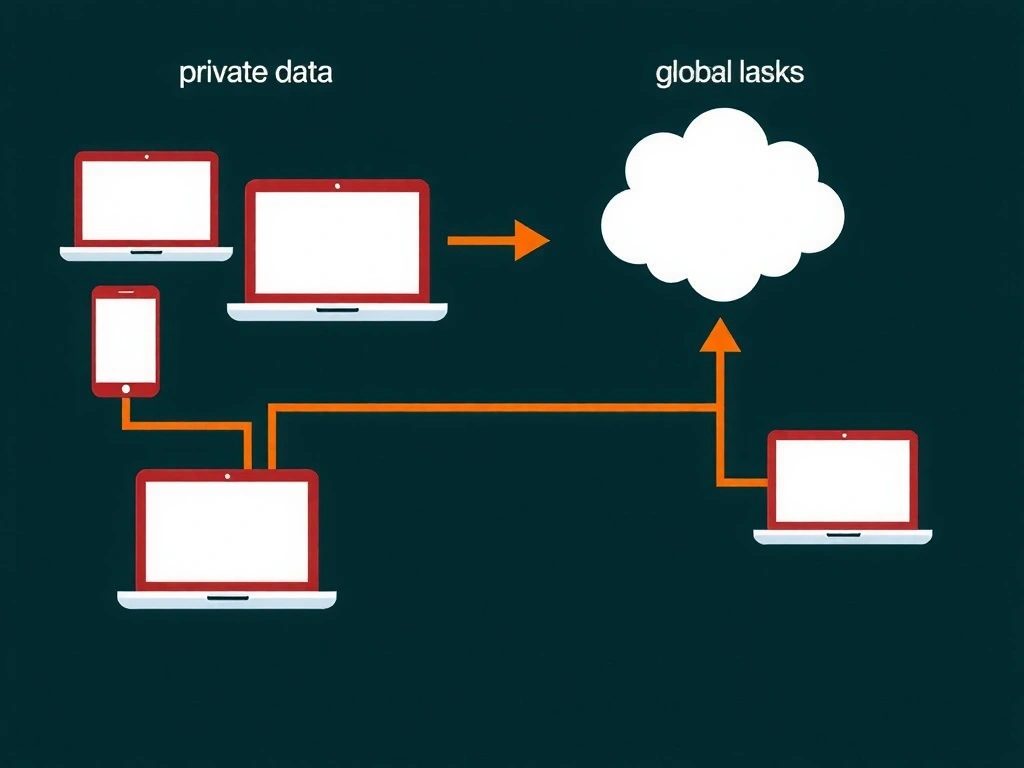
Imagine your boss wants a better phone keyboard model—but legal says user keystrokes never leave the devices. Federated learning is the move: each phone trains a little, sends model updates, not the raw text, and a server averages those updates into a better global model. Think of it like everyone improving a shared recipe by mailing spice notes, not their whole pantry. Exam trap: calling that transfer learning, or confusing it with "dump all data in one warehouse and train." Opposite idea. Federated = decentralized data, coordinated model. Remember that and you're golden.
Full explanation below image
Full Explanation
Federated learning is a distributed training paradigm in which multiple clients—phones, hospitals, edge devices, enterprises—collaboratively improve a shared model without uploading their full raw datasets to a central training store. Typically a coordinating server distributes current weights; clients compute updates on local data; updates are aggregated (for example via federated averaging); the global model advances. The design goal is often privacy, data residency, bandwidth savings, or regulatory compliance—raw examples stay local while knowledge in parameter form is shared.
It is not simply training on a big public dataset, which is centralized learning. It is not transfer learning, which is about reusing representations across tasks and can be used with many training setups. It is the opposite of collecting all raw multi-source data onto one server first. Those distractors are common because they also appear in modern ML workflows, but they answer different questions.
Practical caveats include non-IID client data, stragglers, secure aggregation, differential privacy, and communication cost. Systems must handle clients that drop offline and updates that are biased toward high-activity users. Evaluation should reflect real client distributions, not only a pooled lab set.
Underlying principle: move the model to the data rather than moving all raw data to the model. Best practice combines federation with encryption or secure aggregation, monitors fairness across clients, and documents what still leaves the device (gradients can leak information if unprotected). Memory aid: federated learning means the model travels and raw data stays home. When legal or privacy constraints forbid centralizing raw records, federation is the pattern to recognize on the exam.