
An AI system is excellent at one bounded skill—such as mastering a board game or operating within a constrained driving stack—but does not exhibit human-level general intelligence. What category does this system fall into?
Select an answer to reveal the explanation.
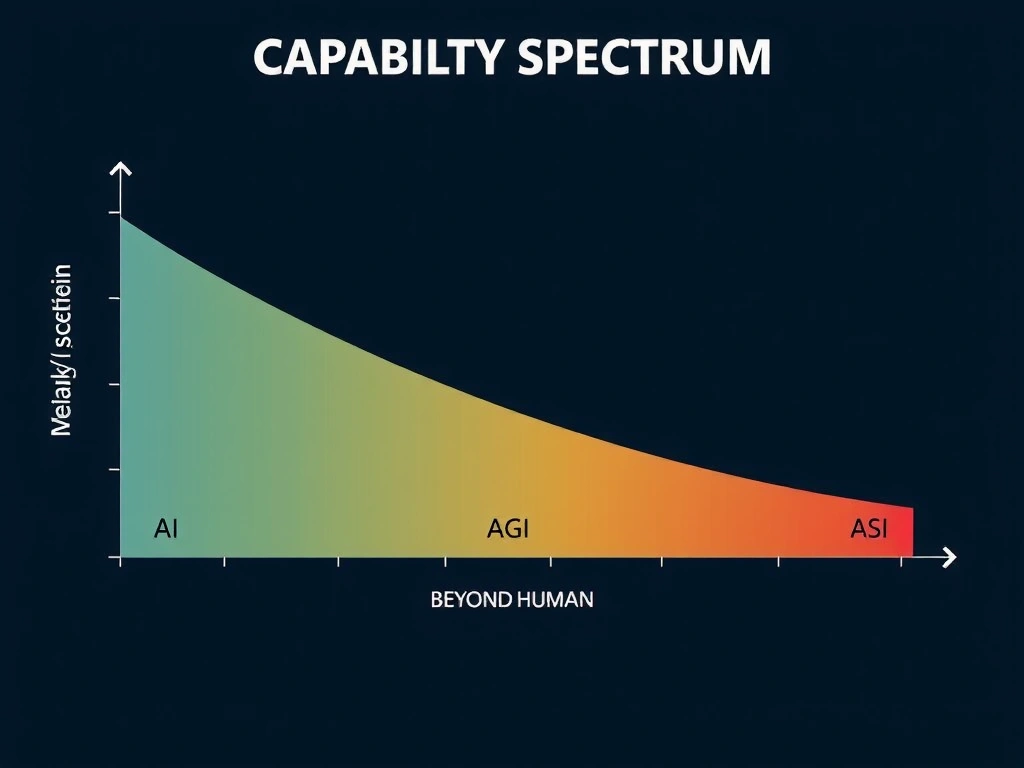
Short Explanation and Infographic
Your boss says, "We built AI that drives better than half the city." Cool—but that still doesn't mean the car can write a novel, diagnose rare diseases, and negotiate your lease. That's narrow AI (weak AI): one lane of excellence. AGI would be the generalist mind; ASI is the sci-fi "smarter than us at almost everything" level. Exam trap: treating the bare phrase "artificial intelligence" as if it already meant AGI. Nope—almost everything in production is narrow. When you see chess, Go, or domain-limited driving, answer narrow/weak AI and move on. Trust me on this one—it shows up constantly.
Full explanation below image
Full Explanation
Narrow AI, synonymously weak AI in many curricula, describes systems designed and evaluated for particular tasks or tightly scoped domains. A chess engine, a medical image classifier for one modality, or a constrained autonomous-driving stack can outperform humans within their envelope without transferring that competence arbitrarily to unrelated problems. That specialization is the defining trait of the category in the question: excellence at a bounded skill without human-level general intelligence.
Artificial general intelligence denotes systems with broad, adaptable intelligence across diverse tasks at roughly human generality. Artificial superintelligence goes further, positing intelligence that surpasses humans widely. Neither label fits a single-domain specialist. The umbrella term artificial intelligence covers the entire field, including predominantly narrow systems; it does not by itself mean AGI or a human-level mind. Treating every “AI” product as general intelligence is a marketing error and an exam trap.
For exams and design reviews, classify by breadth of capability: task-specific means narrow or weak; human-broad means AGI; beyond human across domains means ASI. Most deployed systems today are narrow even when they use large models, because products constrain tools, prompts, and evaluation to specific jobs. Transfer learning and foundation models widen reuse but do not automatically deliver AGI.
Underlying principle: capability breadth—not marketing labels—separates narrow AI from AGI and ASI. Best practice defines the task boundary, metrics, and out-of-scope behaviors explicitly. Memory aid: great at one job equals narrow AI; great at most jobs like a person equals AGI; vastly beyond people equals ASI. When you see chess, Go, or domain-limited driving, answer narrow or weak AI.