
When moving from a narrow AI system toward artificial general intelligence (AGI), what is widely considered a core challenge?
Select an answer to reveal the explanation.
Short Explanation and Infographic
Here's the trap: people think AGI is just "make the chess bot better at chess." Nope. Narrow AI can crush one job—translate, detect tumors, recommend videos—and still be clueless at the next desk over. AGI is the generalist: reuse knowledge, switch contexts, learn new skills without starting from zero every time. Imagine your boss says, "This model is great at invoices—now make it run the whole company." That's the leap, and it's hard. Exam trap: "narrow AI is always inaccurate," "just add more labels for the same task," or "we literally have no computers." The real bottleneck is flexible cross-domain generalization. Land that takeaway and you're solid.
Full explanation below image
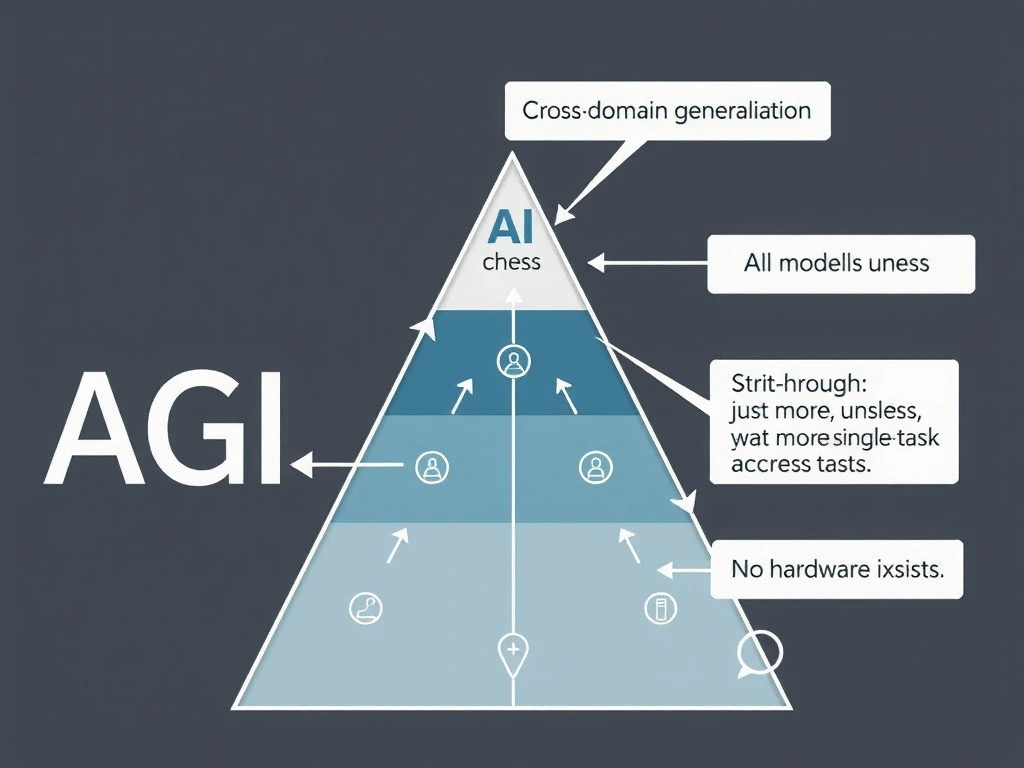
Full Explanation
Narrow (or weak) AI systems are optimized for limited task distributions: a speech recognizer, a fraud detector, a game-playing agent. They can be extremely accurate within that scope yet brittle outside it. Artificial general intelligence refers to systems that can understand, learn, and perform competently across a wide range of cognitive tasks at or beyond human-like flexibility. A central research challenge is therefore generalization and transfer: reusing concepts, skills, and reasoning patterns across domains rather than training a separate specialist for each problem.
The distractors miss this conceptual core. Modern narrow systems frequently deliver high task accuracy, so the obstacle is not that they all fail. Scaling labeled data for a single task improves that task’s empirical risk but does not automatically produce cross-domain competence. Compute and data infrastructure are practical constraints for large models, yet framing AGI’s main challenge as a total absence of IT resources is incorrect and incomplete; even with abundant compute, algorithms for open-ended transfer, robustness, and alignment remain open problems.
Adjacent topics include transfer learning and foundation models (steps toward broader reuse), multi-task and meta-learning, continual learning without catastrophic forgetting, and evaluation beyond single benchmarks. For exams, if a question contrasts narrow AI with AGI, prioritize answers about breadth, flexible knowledge transfer, and multi-domain competence—not raw single-task accuracy, trivial data scale-ups for one job, or blanket hardware shortages. Underlying principle: AGI is about flexible cross-domain competence, not single-task scoreboards or empty hardware shelves. Best practice evaluates transfer, continual learning, and out-of-distribution robustness when claiming progress beyond narrow systems. Memory aid: narrow means specialist; AGI means generalist that transfers across the map.