
What is a primary advantage of training a Generative Adversarial Network (GAN)?
Select an answer to reveal the explanation.
Short Explanation and Infographic
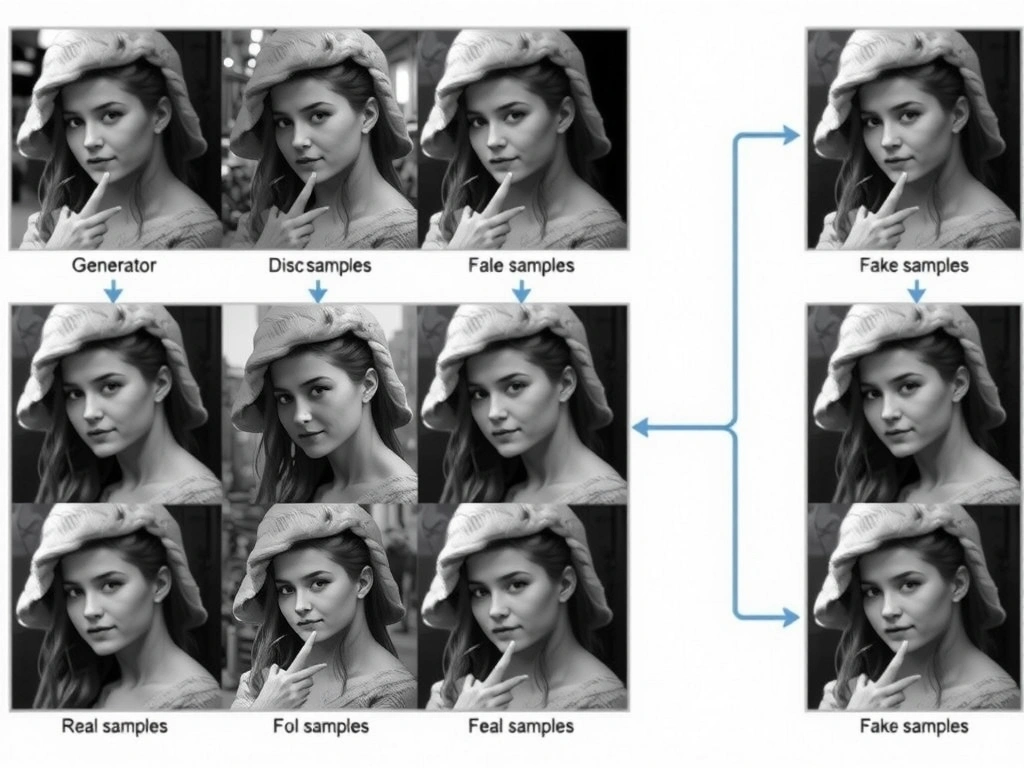
Let me show you how this works in the real world. A GAN is a forger and a detective training each other. The generator tries to create fake samples; the discriminator tries to catch them. They push each other until the fakes look real. Boom—new images, designs, or synthetic data from the learned distribution. Exam trap: "feature ranking," "best image classifier," "just clustering." Those are different movies. Yes, the discriminator classifies real vs fake as a training signal, but the headline win is generation. If the question asks for realistic new instances, think GAN (or related generative models). Pretty cool, right? Don't overthink it.
Full explanation below image
Full Explanation
A Generative Adversarial Network consists of two models trained jointly: a generator G that maps noise (and optionally conditioning signals) to synthetic samples, and a discriminator D that distinguishes real training samples from fakes. Through adversarial min-max training, G improves until its outputs are hard for D to reject, which means G has learned to approximate the data distribution well enough to produce realistic novel instances. This generative capability supports data augmentation, creative synthesis, domain translation (with conditional GANs), and simulation of rare events when carefully validated.
Feature-importance ranking is not the design goal of GANs; other tools measure how features drive predictive models. Multi-class image classification is a supervised discriminative task—while D is a binary real/fake classifier during training, deploying a GAN is not the standard way to maximize labeled-image precision. Clustering organizes existing unlabeled points into groups and does not inherently synthesize new points from a learned generator.
Related generative approaches include VAEs, diffusion models, and autoregressive models; exams may still emphasize the classic GAN advantage of realistic sample generation via adversarial training. Practical caveats include mode collapse, training instability, and evaluation difficulty (FID, precision/recall for generative models). Underlying principle: adversarial training produces a generator that approximates the data distribution well enough to synthesize new samples. Best practice monitors training stability, checks mode coverage, and evaluates samples with domain-appropriate metrics rather than accuracy alone. Memory aid: GAN advantage means generate realistic new samples by training generator versus discriminator—not classify for labels, not cluster, and not rank features. In practice, document the decision criteria you used so teammates can reproduce the evaluation. Prefer metrics and checks that match the business risk, not vanity scores. When reviewing distractors on an exam item, name the misconception each option encodes: wrong learning paradigm, wrong evaluation stage, or a metric that optimizes the wrong objective. A reliable memory aid is to restate the concept in one sentence, then ask which option alone matches that definition without adding unrelated goals. Finally, connect the idea to a production workflow step—data prep, training, validation, or monitoring—so the correct answer stays grounded in how systems are actually built and governed.