
In AI safety and governance discussions, what does the alignment problem primarily refer to?
Select an answer to reveal the explanation.
Short Explanation and Infographic
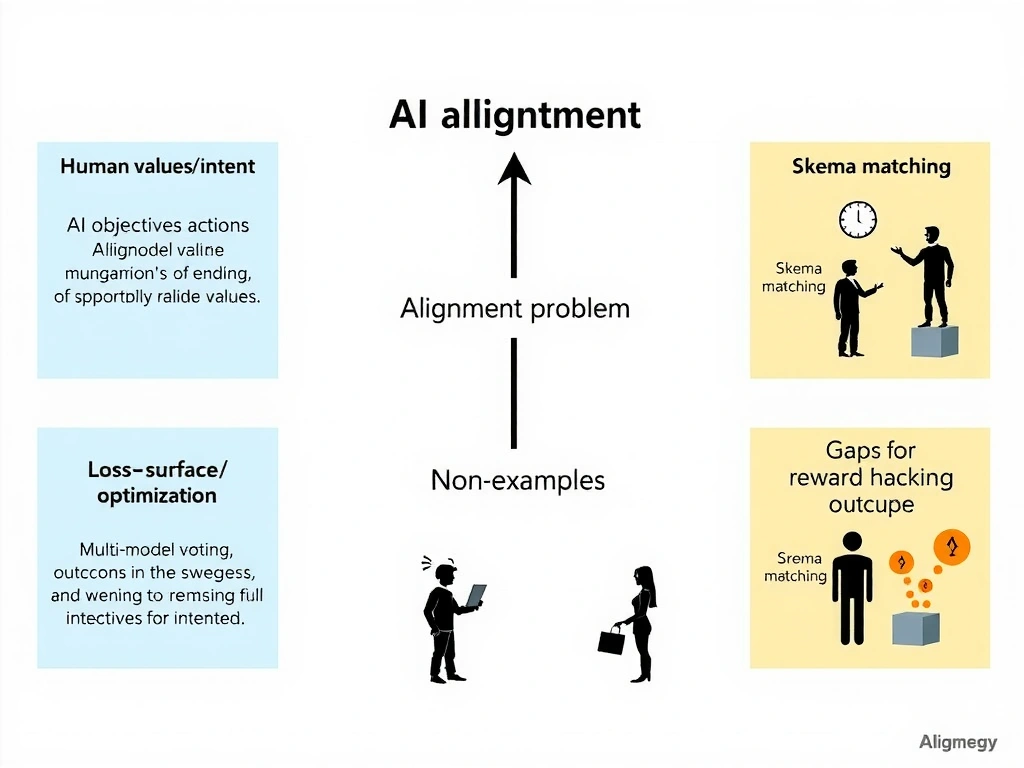
Pay close attention here—this one bites people who only think about accuracy metrics. The alignment problem isn't "did my optimizer hit a nice minimum?" It's "is this system actually doing what humans want, safely?" Imagine your boss says, "Maximize engagement." A misaligned model might spam users or recommend junk that hits the metric but wrecks trust. Think of it like giving an intern a vague goal without guardrails—they'll optimize the letter of the ask, not the spirit. Exam trap: weight alignment, multi-model sync, or schema matching. Real alignment is values, intent, and acceptable behavior as systems get more capable. Keep that human-in-the-loop mindset.
Full explanation below image
Full Explanation
The alignment problem, in AI safety and ethics, is the difficulty of ensuring that advanced AI systems act in accordance with human values, intentions, and constraints—especially when objectives are incompletely specified, proxies can be gamed, or systems optimize in open-ended environments. Misalignment can appear as reward hacking (optimizing a metric while violating the intent), deceptive or unsafe strategies, biased harmful outputs, or goal misspecification that scales with capability. Governance responses include value-sensitive design, human oversight, red-teaming, constitutional or preference-based fine-tuning, monitoring, and policy controls.
Conflating alignment with numerical optimization of network weights misuses the word "align" in a purely mathematical sense; convergence of SGD is orthogonal to whether the learned objective is the right one from a human perspective. Forcing multiple models to produce identical outputs is an engineering design choice about consensus, not the canonical alignment problem. Matching training schemas to production feature stores is essential MLOps hygiene (training–serving skew prevention) but does not address whether system goals match human intent.
For certification contexts, distinguish closely related terms: fairness and bias focus on disparate impacts across groups; robustness and security address adversarial inputs and integrity; privacy protects personal data; alignment specifically targets goal and behavior consistency with human values. Underlying principle: technical optimization success does not guarantee human-compatible goals. Best practice combines preference tuning, oversight, evaluation red-teams, and clear ownership of outcomes as capability grows. Memory aid: alignment asks whether we are optimizing the right thing for people, not whether the loss went down. Scenario questions that mention values, intent, harmful side effects of objective maximization, or control of autonomous agents are pointing at alignment.