
What is Bayesian optimization primarily used for in machine learning workflows?
Select an answer to reveal the explanation.
Short Explanation and Infographic
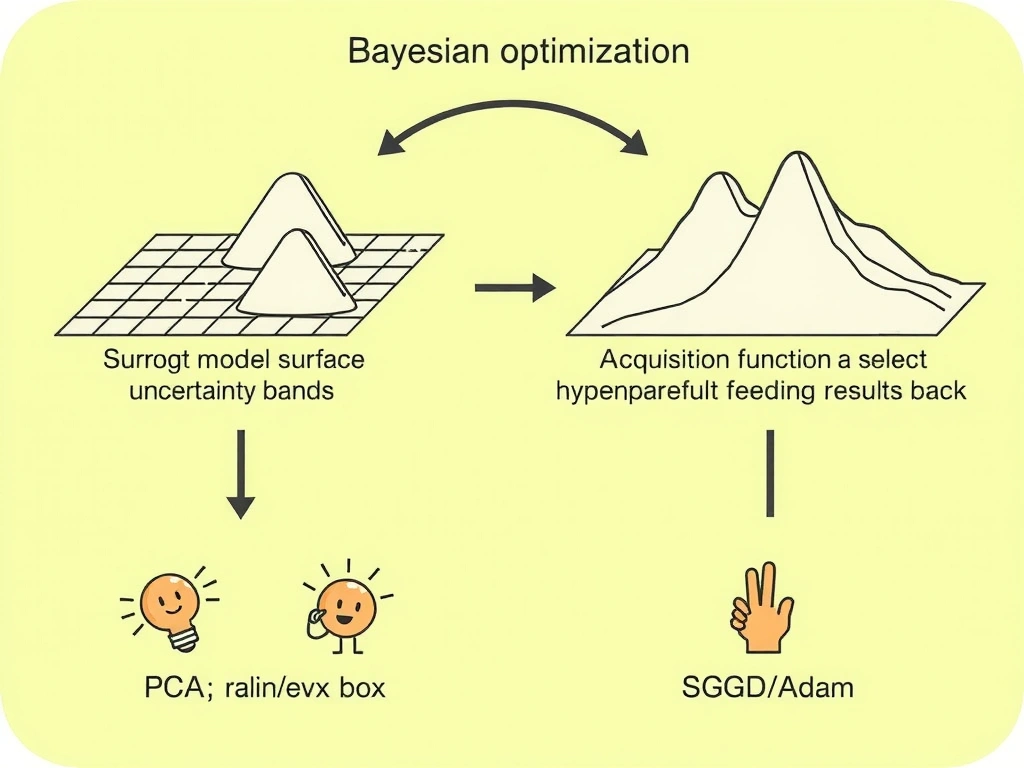
Okay, real talk: training a big model for every random hyperparameter guess gets expensive fast. Bayesian optimization is the smart shopper—it builds a cheap "guess map" of what might work, then picks the next trial where improvement is most likely. Think of it like a chef who doesn't taste every spice combination—after a few tries, they home in. Exam trap: calling it PCA, or thinking it replaces Adam for weight updates, or that it "solves classification perfectly." Nope. It's for hyperparameters (learning rate, depth, regularization…) when evaluations hurt. Fewer wasted runs, better configs. Trust me—know this difference and you'll dodge the easy distractors.
Full explanation below image
Full Explanation
Bayesian optimization (BO) is a sequential strategy for optimizing expensive black-box functions. In ML, the function is often validation performance (or a multi-objective trade-off) as a function of hyperparameters: learning rate, regularization strength, architecture choices, and similar discrete or continuous knobs. BO maintains a probabilistic surrogate model—commonly a Gaussian process, or sometimes tree-based or neural surrogates—that estimates the objective and uncertainty across the search space. An acquisition function (expected improvement, upper confidence bound, probability of improvement, and variants) balances exploration of uncertain regions against exploitation of promising areas, selecting the next configuration to train and evaluate.
This differs sharply from dimensionality reduction, which transforms features rather than tuning external configuration parameters. It also differs from first-order optimizers such as SGD and Adam, which update model parameters during a single training run; BO usually operates at the outer loop, proposing complete training jobs. Finally, BO cannot guarantee perfect classification: data noise, model capacity limits, and non-stationarity still bound achievable performance.
Practitioners choose BO when each evaluation is costly (long training, limited GPU time) and the search space is moderate-dimensional. Alternatives include grid search, random search, successive halving / Hyperband, and population-based training. Underlying principle: BO is sample-efficient outer-loop search for costly black-box objectives such as validation scores over hyperparameters. Best practice pairs a good surrogate with an acquisition that balances explore and exploit, and still validates the winner carefully. Memory aid: Bayesian optimization means smart outer-loop hyperparameter search with a surrogate and acquisition—not how weights move each step and not feature compression. On exams, map the tool to the job: expensive trials plus hyperparameter space points to BO.