
What is the fundamental distinction between a supervised learning problem and an unsupervised learning problem?
Select an answer to reveal the explanation.
Short Explanation and Infographic
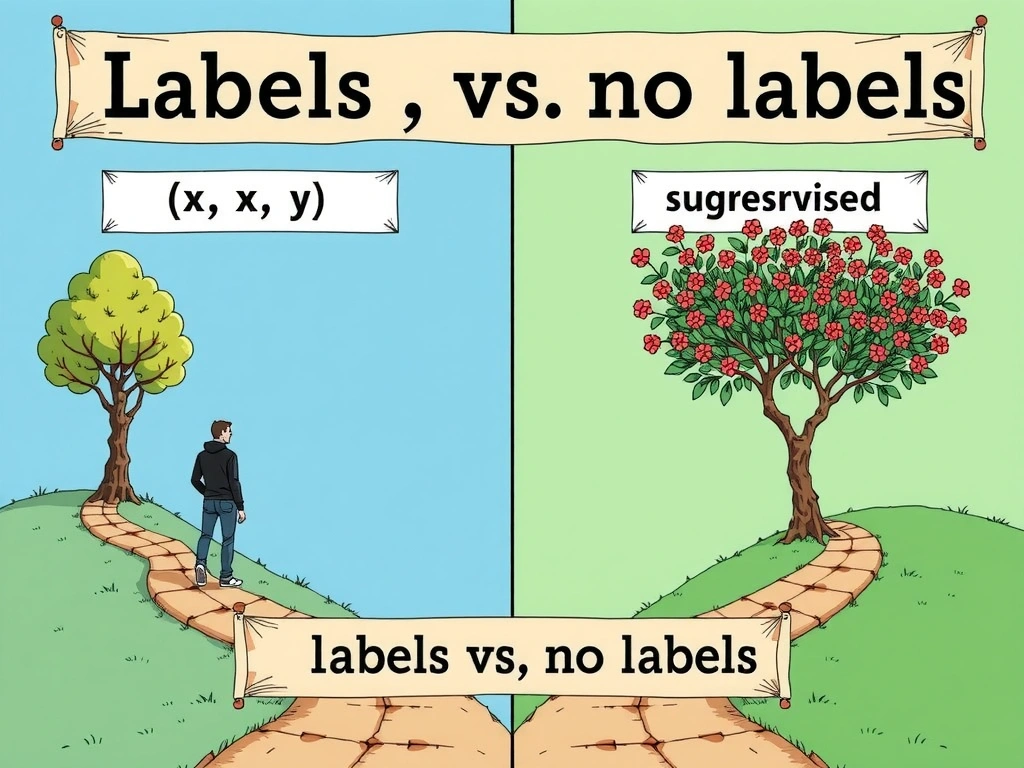
Let's keep this clean. Supervised means the teacher graded the homework—every training row has the right answer (label or number). Unsupervised means you get a pile of ungraded papers and look for patterns yourself—clusters, weird outliers, natural groupings. That's the whole split. Exam trap: "supervised = harder compute," "supervised = regression only," "structured vs unstructured." Nope. You can run k-means on tables or images; you can classify text or sensor rows. Labels vs no labels—remember that and you won't get baited. If your boss drops a CSV with a "target" column, you're in supervised land. No target column? Start thinking unsupervised. Simple, but it shows up constantly on the test.
Full explanation below image
Full Explanation
Supervised learning uses a training set of input–target pairs. The target may be a discrete class (classification) or a continuous value (regression). The algorithm learns a mapping from inputs to targets and is evaluated by how well that mapping predicts targets on held-out data. Unsupervised learning receives inputs without target annotations and seeks structure: clusters of similar instances, low-dimensional embeddings, density models, association patterns, and so on. Evaluation is often internal (silhouette, reconstruction error) or downstream (usefulness for a later supervised task).
The incorrect options confuse this definition with secondary properties. Computational cost and model depth vary widely within both families; a linear regressor can be cheaper than a large unsupervised generative model. Task-type confusions are common on exams: classification requires labels and is therefore supervised, while unsupervised methods do not assign instances to predefined class names. Data modality is orthogonal—both supervised and unsupervised methods are routinely applied to tables, images, audio, and text.
Semi-supervised and self-supervised learning sit between or adjacent to these poles (few labels, or labels generated from the data itself), but the exam still expects the classic definition: labels present → supervised; labels absent, structure discovery → unsupervised. Underlying principle: the presence or absence of training targets defines the paradigm more cleanly than compute, modality, or marketing labels. Best practice starts project design by asking whether labels exist, how costly they are, and which metrics fit the paradigm. Memory aid: graded homework versus find the natural piles. When reading a scenario, ask first whether target values are provided for training—that single question usually identifies the paradigm.