
Which description best captures transfer learning in modern machine learning practice?
Select an answer to reveal the explanation.
Short Explanation and Infographic
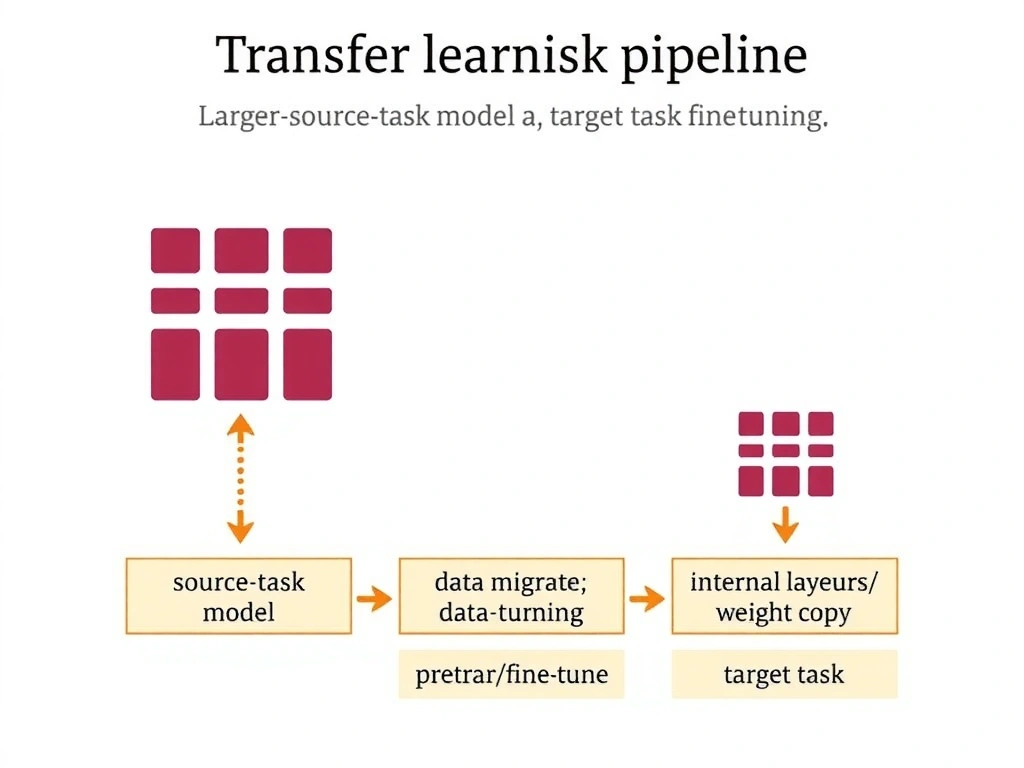
Here's where it gets interesting for you. Transfer learning is "don't reinvent the wheel." Someone already trained a model that recognizes edges, textures, or language structure—you borrow those brains and fine-tune for your task. Think of it like hiring a seasoned chef for a new restaurant: they already know knife skills; you just teach them your menu. Exam trap: "train from scratch every time," "move the data files," or "copy weights between layers of one untrained net"—not the same idea. Pay close attention: reuse a pre-trained model on a related problem. Saves data, time, and GPU budget. That's the move in CV and NLP every day.
Full explanation below image
Full Explanation
Transfer learning is the practice of leveraging knowledge acquired while solving one problem to improve learning on a different but related problem. In deep learning, this usually means starting from a model pretrained on a large source dataset (for example, ImageNet for vision or a large language corpus for NLP), then adapting it to a target task via fine-tuning some or all weights, or via freezing early layers and training a new head (feature extraction). The value proposition is sample efficiency, faster convergence, and often better accuracy when target labels are scarce or expensive.
Training from scratch on a large generic dataset for every new project forgoes those benefits and is not what practitioners mean by transfer learning—though pretraining itself may be the source stage of a transfer pipeline. Migrating raw data between systems is an infrastructure or ETL concern and does not transfer learned representations. Copying parameters between layers within a single untrained network may implement weight tying or architectural constraints, but it is not transfer of knowledge from a previously solved task.
Related concepts include domain adaptation (distribution shift between source and target), multi-task learning (joint training), and foundation models (broad pretraining intended for many downstream uses). Risks include negative transfer when source and target are poorly related, and leakage of source-domain biases into the target application. Underlying principle: reuse of previously learned representations accelerates and stabilizes learning on related targets. Best practice freezes or fine-tunes layers deliberately, watches for negative transfer, and validates on target-domain data. Exam memory aid: transfer means start from a pretrained related model and adapt; it is about reusing learned parameters or representations, not shuffling raw tables or randomly reinitializing every time.