
What is the primary goal of a clustering method such as k-means?
Select an answer to reveal the explanation.
Short Explanation and Infographic
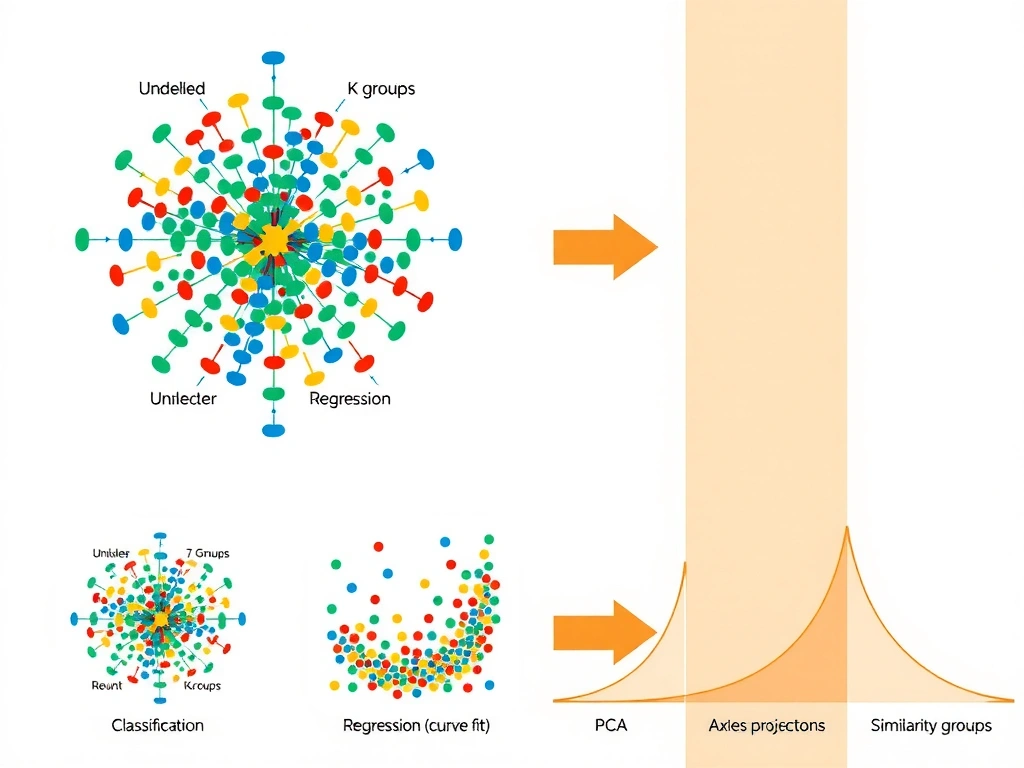
Check this out: k-means is your unsupervised "sort the junk drawer" tool. Nobody handed you sticky labels that say "screws" or "batteries"—you just pile things that look alike. That's clustering: group by similarity, not by a teacher-provided class list. Exam trap: folks confuse it with classification (labels known), regression (predict a number), or PCA (shrink features). Different jobs. K-means drops k centroids, assigns points to the nearest one, and updates until things settle. If the question says "group unlabeled points by similarity," you're in clustering land. Simple idea, huge in customer segments, anomaly hunting, and preprocessing. Keep rolling.
Full explanation below image
Full Explanation
Clustering algorithms partition a dataset into subsets (clusters) so that members of the same cluster are more similar to each other than to members of other clusters, according to a chosen distance or similarity measure. K-means is a canonical example: the practitioner selects k, initializes k centroids, assigns each point to the nearest centroid, recomputes centroids as cluster means, and iterates until assignments stabilize or a budget is exhausted. No ground-truth class labels are required; the algorithm discovers structure in unlabeled data—hence unsupervised learning.
Supervised classification instead maps inputs to predefined categories using labeled examples; that is a different problem statement even when both produce "groups" in casual language. Regression predicts continuous targets and likewise needs labeled (x, y) pairs. Dimensionality-reduction techniques such as PCA transform the feature space to fewer coordinates that preserve variance or structure; they may be used before clustering, but they do not themselves define the clustering objective of grouping instances.
In practice, k-means assumes roughly spherical, similarly scaled clusters and is sensitive to feature scaling and the choice of k (often tuned with silhouette scores, elbow plots, or domain knowledge). Alternatives include hierarchical clustering, DBSCAN (density-based, variable cluster shapes), and Gaussian mixture models (soft membership). Underlying principle: clustering discovers groups from similarity without needing predefined class names. Best practice scales features, validates k with domain judgment and internal metrics, and does not confuse clusters with supervised labels. For the exam, map the verbs carefully: classify with labels means supervised classification; predict a number means regression; shrink dimensions means feature reduction; group by similarity without labels means clustering.