
In natural language processing, what does stemming accomplish?
Select an answer to reveal the explanation.
Short Explanation and Infographic
Okay, let's talk text prep. Stemming is the rough chainsaw that chops words back toward a root so “connect,” “connected,” and “connection” can count as related in a bag-of-words world. Think of it like filing different spellings of a last name under one folder—even if the cut is a bit ugly. Exam trap: confusing stemming with stop-word removal, synonym clustering, or “make text digital.” Different jobs. Lemmatization is the nicer cousin that uses real dictionary forms—know both exist. When your boss wants cheaper IR features yesterday, stemming still shows up. Takeaway: stemming = reduce words to a stem/base form.
Full explanation below image
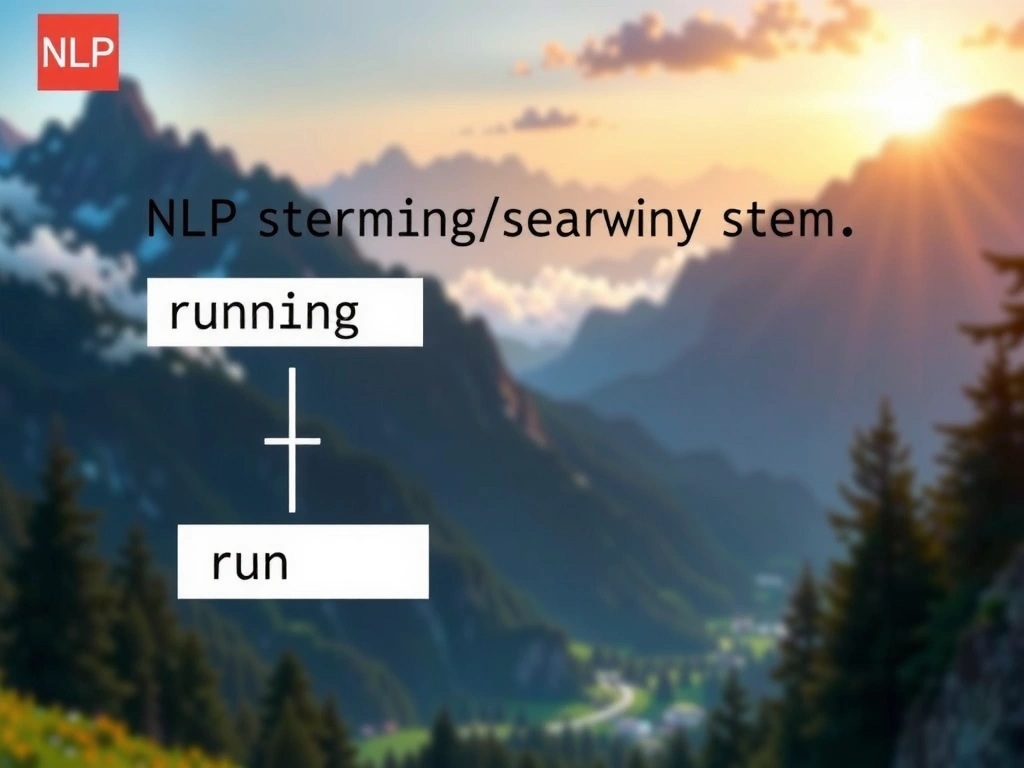
Full Explanation
Stemming is a morphological normalization technique in NLP pipelines, especially classical information retrieval and count-based models. Algorithms apply heuristic suffix rules to map surface forms to a stem, reducing vocabulary sparsity so that related inflections contribute to the same feature. The Porter and Snowball stemmers are canonical English examples. Stems need not be valid dictionary words; the goal is consistent conflation, not linguistic perfection. That cheap consistency can improve recall in search and reduce dimensionality in bag-of-words models.
Stemming differs from lemmatization, which uses vocabularies and morphological analysis to return a lemma (for example mapping “better” toward “good”). It differs from stop-word removal, which filters frequent function words. It is not about digitizing media or about pure semantic synonym grouping via embeddings—though all may appear in a broader preprocessing stack. Converting speech to compressed files is signal processing; clustering tokens by meaning is semantic similarity work, not morphological cutting.
Trade-offs matter: aggressive stemming can over-conflate unrelated words (overstemming) or miss variants (understemming). Modern contextual embeddings sometimes reduce the need for stemming because the encoder already shares information across forms, but exams still test the definition. Choose stemming when you need fast, rule-based normalization; choose lemmatization when dictionary-correct bases matter more.
Underlying principle: morphological normalization merges surface variants before counting or retrieval. Best practice documents the stemmer version, evaluates retrieval quality with and without stemming, and does not confuse stemming with stop-word lists or synonym expansion. Memory aid: stem means chop endings; lemma means proper base word; stop words means drop common glue words. When the question asks what stemming accomplishes, answer reduction of inflected forms to a common stem.