
In gradient-based training, what does the learning rate primarily control?
Select an answer to reveal the explanation.
Short Explanation and Infographic
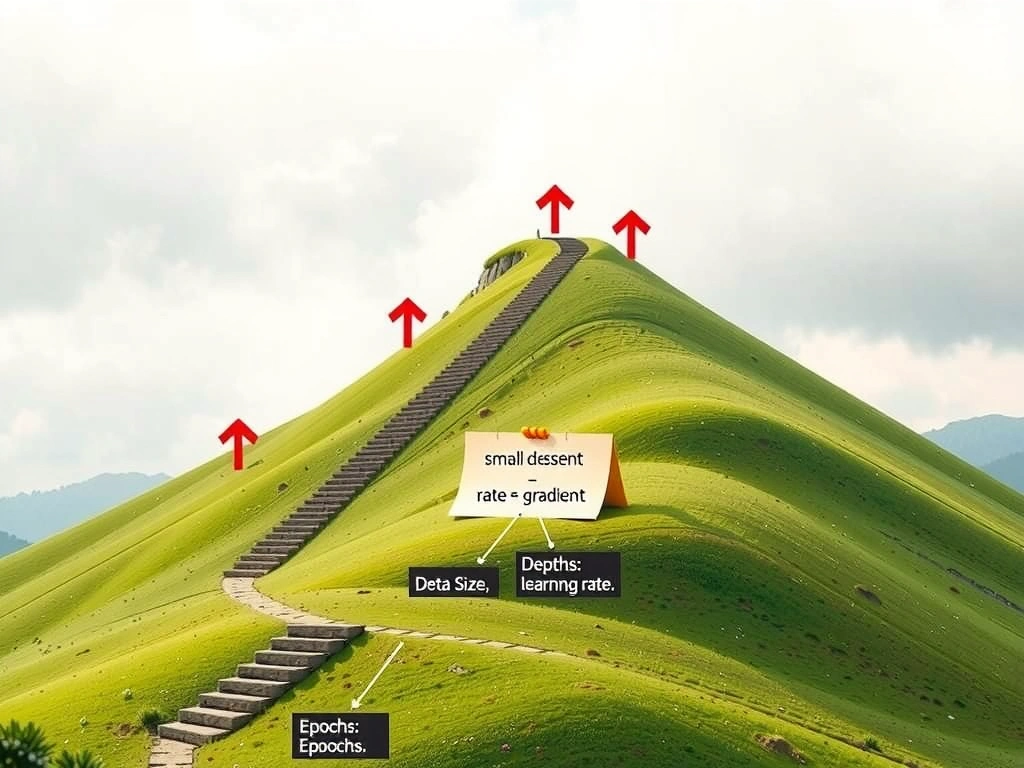
Pay close attention here, because this one bites people in production all the time. Learning rate is the gas pedal on each weight update. Too big and you overshoot the valley—loss goes haywire. Too small and you’re crawling forever. Think of walking downhill in the fog: the gradient says which way, the learning rate says how long a stride. Exam trap: mixing it up with dataset size, layer count, or epoch count. Those matter, but they’re not the step-size knob. When your boss asks why training diverged after a hyperparameter tweak, check the learning rate first. Takeaway: LR scales the update vs the gradient.
Full explanation below image
Full Explanation
In gradient descent and its variants, parameters are updated roughly by subtracting the learning rate times a gradient estimate. Thus the learning rate controls the scale of each step toward lower loss. Schedules such as step decay, cosine annealing, and warm-up vary the rate over time; adaptive optimizers such as Adam and RMSProp rescale directions but still expose a base step-size hyperparameter. Selecting that scale is among the most consequential optimization choices in practice.
Learning rate does not set the number of training examples, the depth of the network, or the number of epochs. Those are separate design choices about data, architecture, and training schedule length. Poor learning-rate selection causes divergence when too large, slow convergence when too small, or failure to escape plateaus. Practical workflows combine validation monitoring with learning-rate finder heuristics or scheduled decays, and they treat the rate as a tunable hyperparameter rather than a fixed constant forever.
When training is unstable, reducing the learning rate or adding warm-up often helps; when progress stalls with a healthy loss landscape, a slightly larger rate or a schedule restart may help. Always decouple this diagnosis from needing more layers or more epochs, which address different bottlenecks.
Underlying principle: optimization step size is distinct from model capacity and data volume. Best practice logs learning-rate schedules, pairs them with gradient clipping when needed, and validates that final performance is not an artifact of an unlucky fixed rate. Memory aid: gradient equals direction; learning rate equals stride length; epochs equal how many laps; architecture equals the track layout. On the exam, any option that redefines learning rate as data size, layer count, or epoch count is a distractor.