
In modern analytics and AI pipelines, which statement best describes what practitioners mean by Big Data?
Select an answer to reveal the explanation.
Short Explanation and Infographic
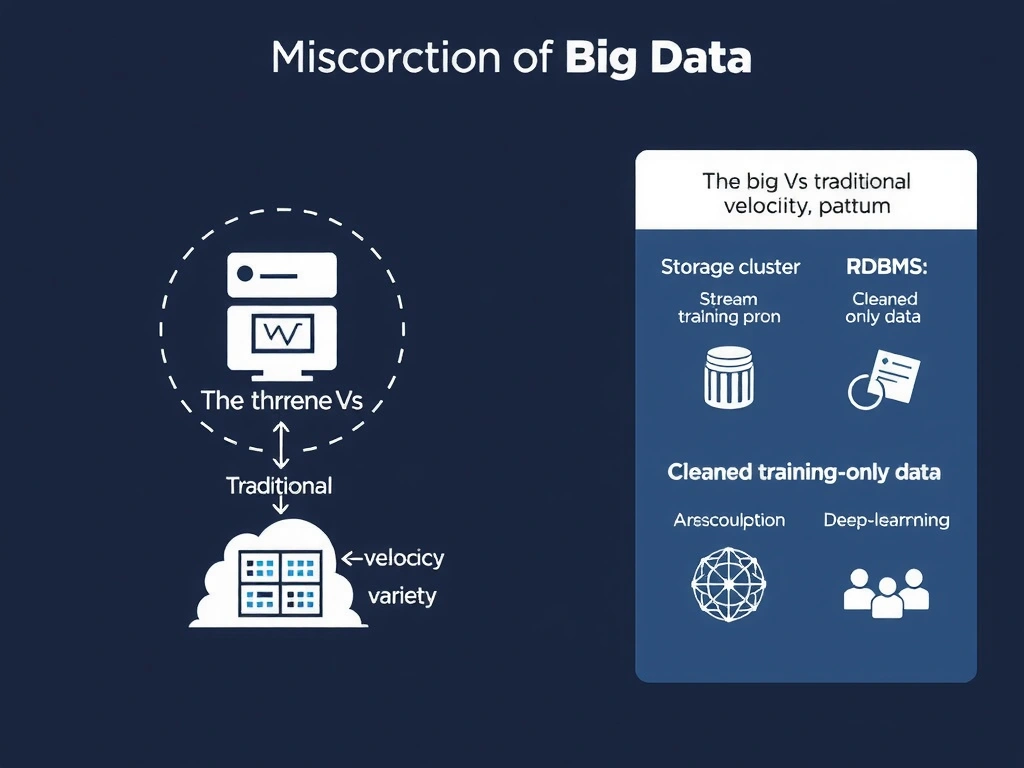
Here's the deal: "Big Data" isn't just "a lot of rows." Think of it like trying to drink from a fire hose with a coffee mug—volume, speed, and messy variety overwhelm the old tools. Traditional SQL boxes and single-server scripts choke when the fire hose never stops. So teams reach for distributed storage, stream processing, and scale-out compute. Exam trap: don't pick "stored in one big database" or "cleaned for deep learning." Those miss the point. Big Data means the data is too large, too fast, or too complex for the old playbook. Got it? Sweet—remember the fire hose, not just "big file."
Full explanation below image
Full Explanation
Big Data refers to data assets whose scale or complexity outstrips conventional processing approaches. Industry discussions commonly organize this around the "V" dimensions—especially volume (sheer size), velocity (ingest and update rate), and variety (structured, semi-structured, and unstructured forms)—and often add veracity and value. When any combination of these factors makes single-machine ETL, classic RDBMS queries, or desktop analytics impractical, organizations adopt specialized stacks: distributed file systems and object stores, cluster compute frameworks, stream processors, and scalable data lakes or warehouses.
The correct option captures that operational reality: Big Data is defined by the mismatch between the data and traditional methods, not by a single product or workflow step. Storing everything in one large database does not automatically qualify as Big Data; many large but well-modeled operational databases remain within traditional tooling. Similarly, cleaned and prepared training sets describe a stage of the ML pipeline, not the defining property of Big Data—much of Big Data work is precisely about handling raw, noisy, multi-format inputs. Restricting the term to deep-learning training sets is too narrow: recommendation logs, sensor streams, clickstreams, and document corpora all illustrate Big Data challenges even when deep learning is not involved.
Underlying principle: Big Data is defined by operational scale challenges—volume, velocity, variety—against conventional tooling, not by storage location alone. Best practice designs distributed pipelines for the V's that actually hurt and keeps governance for quality and access. Memory aid: if ordinary tools still work comfortably end to end, you may have a lot of data, but you do not yet have the Big Data problem. When scale forces architectural change—sharding, distributed jobs, stream windows, columnar lakehouse designs—you are in Big Data territory. On certification exams, prefer definitions tied to processing limits and the V's over storage location, cleanliness, or a single model family.