
In current AI terminology, what does a generative AI model do?
Select an answer to reveal the explanation.
Short Explanation and Infographic
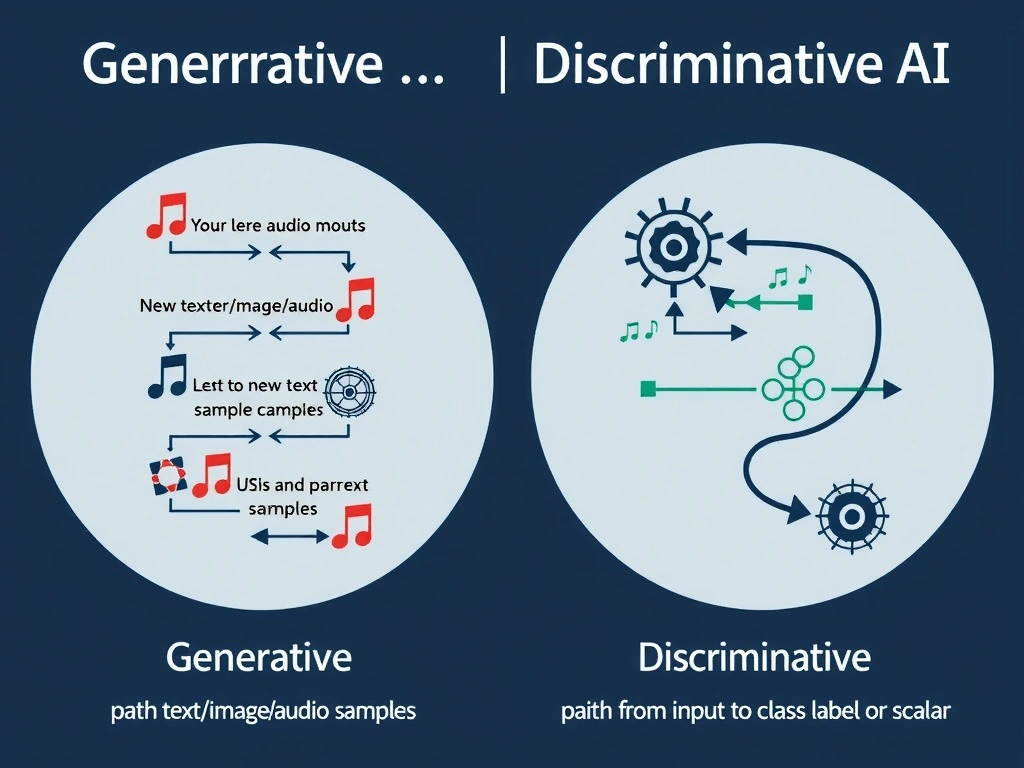
Here's the deal: discriminative models draw boundaries—“spam or not,” “cat or dog.” Generative models make stuff. New paragraphs, new images, new code stubs that didn’t exist in the training file as-is. Think of it like a chef who can cook new dishes in a cuisine, not just taste-test which plate is lasagna. Exam trap: answers that stop at “finds patterns” or “classifies categories.” Finding patterns is necessary; generating is the headline. When your boss wants a draft blog or a mock UI image from a prompt, that’s generative AI. Land it: create original content samples.
Full explanation below image
Full Explanation
Generative AI refers to models that synthesize new content resembling a training distribution. Modern examples include large language models for text and code, diffusion and GAN-based systems for images, and multimodal models that map between modalities. Technically, many such systems approximate the data distribution or learn conditional generators so that sampling yields novel instances rather than mere retrieval of training rows. Evaluation may use automated metrics, human preference, or task success depending on modality.
Discriminative models instead focus on labeling inputs for classification or on regression functions for continuous targets. While a generative model can sometimes support discrimination via Bayes rules or shared representations, the defining product is creation of new samples. Pure data mining that only surfaces correlations without a generator is not generative AI in the product sense used on exams today. Predicting a single continuous number is classic regression and does not capture high-dimensional structured generation of paragraphs or images.
Related distinctions: supervised classifiers, unsupervised clusterers, and generative models can share neural backbones, but evaluation differs—perplexity, FID, human preference, and task success versus accuracy-style metrics alone. Risks include hallucination, copyright concerns, and misuse; governance and evaluation must match the generative use case.
Underlying principle: generative systems produce new instances; discriminative systems score or label existing ones. Best practice clarifies whether the product needs creation or classification, and measures quality with metrics suited to generation. Memory aid: generative means make a new example; discriminative means label this example. When the stem emphasizes producing novel text, images, audio, or code, choose generative AI.