
What is a defining characteristic of a graph neural network (GNN)?
Select an answer to reveal the explanation.
Short Explanation and Infographic
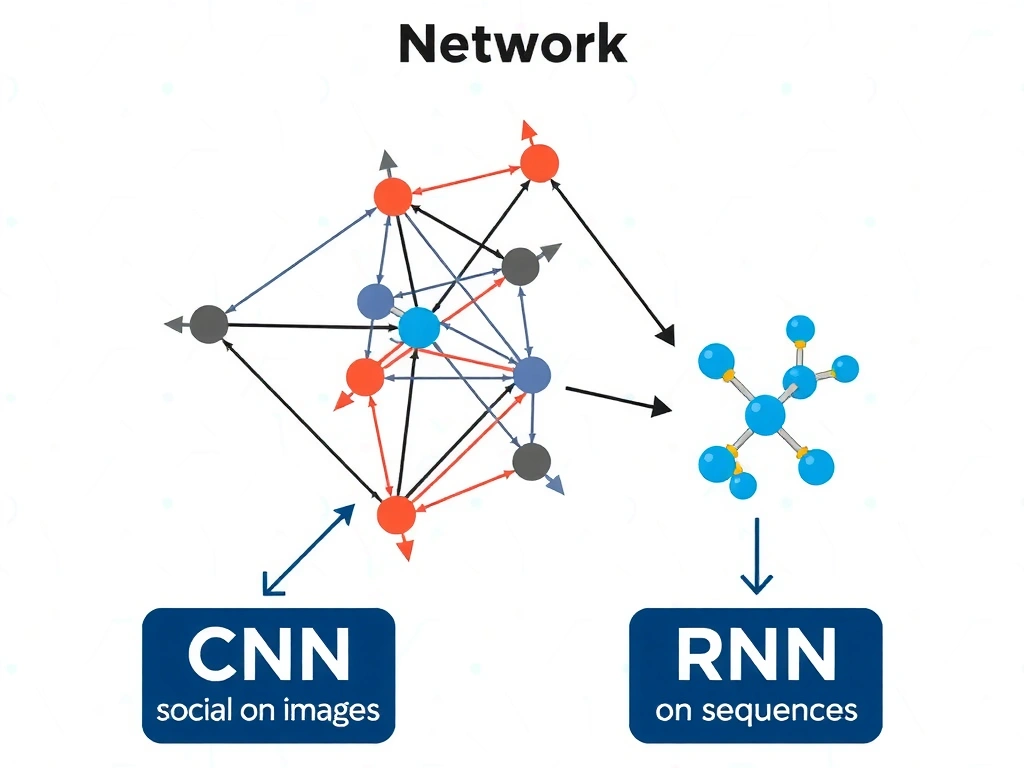
Check this out: not everything is a neat grid or a line of tokens. Sometimes your data is people following people, atoms bonded to atoms, routers linked to routers. That’s a graph—and GNNs are the tool built for it. Nodes talk to neighbors, messages hop along edges, representations update. Exam trap: calling a GNN “just an RNN” or “the image network.” Different shape of data, different architecture. When your boss dumps a knowledge graph and asks for node labels, you’re not forcing a plain CNN. Takeaway: GNN = learn on graph-structured relationships.
Full explanation below image
Full Explanation
Graph neural networks are neural architectures whose inductive bias matches graph-structured data: a set of nodes connected by edges, optionally with node and edge features and directions or types. Core computation is iterative message passing—each node aggregates information from its neighborhood and updates its embedding. Tasks include node classification, link prediction, community-related inference, and whole-graph prediction (for example molecular property prediction). The topology is first-class: who is connected to whom shapes the representation.
GNNs are not restricted to unsupervised learning; many flagship applications are supervised or semi-supervised, with labels on a subset of nodes. They are not the default model for Euclidean image grids—convolutional nets and vision transformers dominate that space—although scene graphs or superpixel graphs can be GNN inputs. They are also not merely rebranded RNNs: recurrence assumes sequential structure, whereas GNNs handle irregular connectivity and permutation-related symmetries appropriate to graphs. Sequence models and graph models answer different structural assumptions.
Popular families include GCN, GraphSAGE, GAT, and message-passing neural networks more generally. Practical issues include over-smoothing with too many layers, scalability on large graphs, and heterophily when neighbors differ in label. Feature engineering on nodes and edges still matters, as does careful train and validation splits that avoid leakage across edges.
Underlying principle: match architecture to data geometry. Memory aid: if the natural picture of your data is dots and lines, think GNN; if it is a matrix of pixels, think CNN; if it is a time-ordered sequence, think RNN or Transformer. On exams, the defining characteristic is learning from graph-structured entities and relationships via neighborhood aggregation—not “unsupervised only,” not “images only,” and not “just another RNN.”