
Which metric is commonly used to evaluate how well a regression model predicts continuous targets?
Select an answer to reveal the explanation.
Short Explanation and Infographic
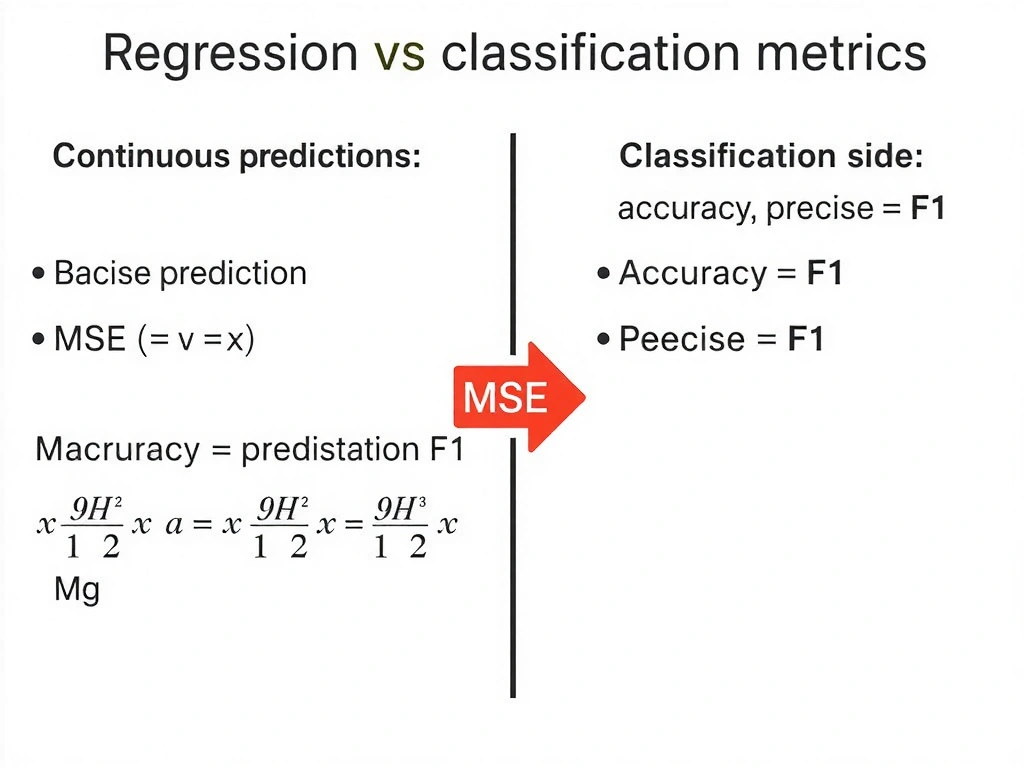
Here's where people trip. Regression predicts numbers—house prices, temperature, demand—not class names. So you measure how far off the number is. Mean squared error is the classic: square the misses so big mistakes scream louder, then average. Accuracy, precision, F1? Those are classification scoreboards. Exam trap is dragging classification metrics onto regression questions because they feel familiar. When your boss asks “how wrong are our price forecasts on average?” you’re talking MSE, RMSE, MAE—not F1. Takeaway: continuous targets → error metrics like MSE.
Full explanation below image
Full Explanation
Regression models predict continuous (or at least ordered numeric) targets. Evaluation therefore focuses on the magnitude of residual error. Mean squared error (MSE) is defined as the average of squared differences between predictions and ground truth. Squaring penalizes large errors more heavily and yields a differentiable loss used widely in training and reporting. Closely related metrics include root mean squared error (RMSE), mean absolute error (MAE), mean absolute percentage error (MAPE), and coefficients of determination such as R². Choice among them depends on outlier sensitivity and interpretability needs.
Accuracy, precision, and F1-score are classification metrics. Accuracy is the proportion of correct discrete labels. Precision emphasizes correctness among predicted positives; F1 balances precision and recall. Applying them unchanged to raw continuous outputs is inappropriate without first defining thresholds that convert the problem into classification—which changes the task and the meaning of errors. A house-price model that is off by ten thousand dollars is not usefully summarized as accuracy unless bins are defined deliberately.
Exam strategy: map the output type first. Classes point to the confusion-matrix family of metrics; continuous targets point to residual-based metrics. Also note that MSE is sensitive to outliers because of squaring; MAE may be preferred when robustness to outliers matters. Units of MSE are squared target units, which is why RMSE is often reported for interpretability on the original scale. Always align the reported metric with stakeholder decisions (absolute dollars versus relative error).
Underlying principle: the metric must match the prediction type and the cost of mistakes. Best practice reports multiple residual metrics, inspects error distributions, and avoids dragging classification scoreboards onto regression problems. Memory aid: continuous targets imply error metrics such as MSE, RMSE, or MAE—not F1, precision, or plain accuracy.