
What is the central objective of reinforcement learning as a learning paradigm?
Select an answer to reveal the explanation.
Short Explanation and Infographic
Okay, let's dive in. Reinforcement learning is trial-and-error with a scoreboard. You (the agent) poke the world, get a reward or a slap on the wrist, and learn which moves pay off long-term—not just the next click. Think of teaching a dog: treat for sit, nothing for chewing the remote. Exam trap: mixing RL with unsupervised clustering or plain supervised labels. No reward loop, no RL. When your boss says “the bot should learn from outcomes, not a giant labeled spreadsheet,” you’re in RL territory. Land it: sequence of decisions, maximize reward. Got it? Sweet.
Full explanation below image
Full Explanation
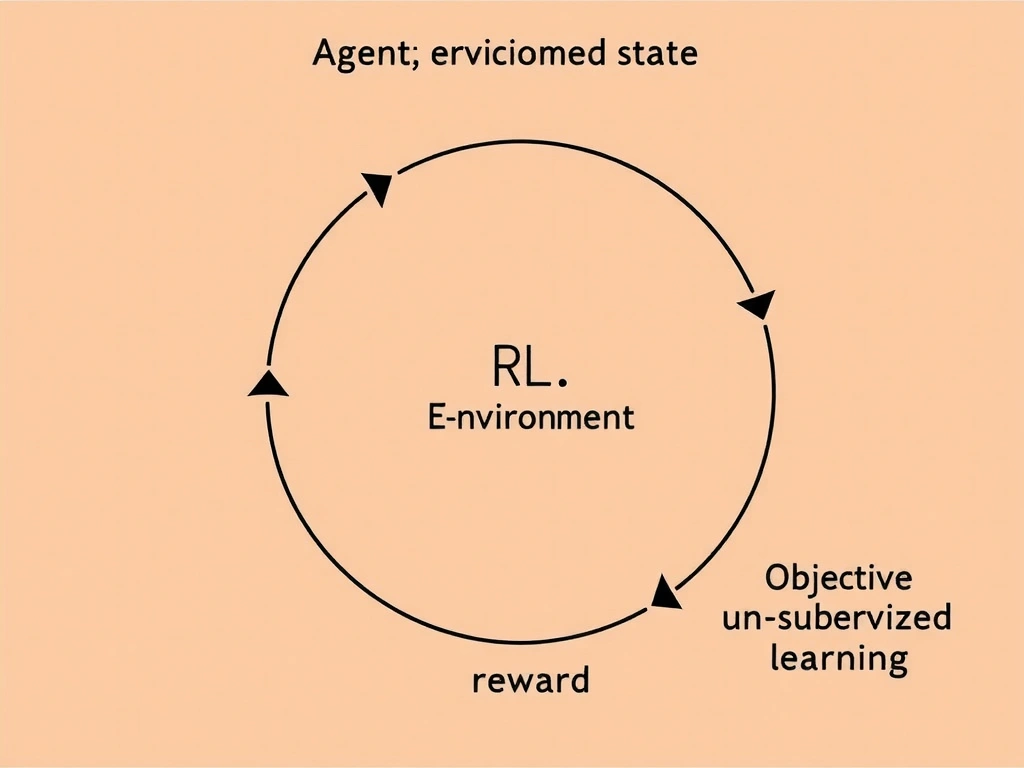
Reinforcement learning (RL) studies how an agent can learn a policy that maps states to actions by interacting with an environment. At each step the agent observes a state or observation, selects an action, receives a scalar reward, and transitions to a new state. The objective is to maximize expected cumulative reward (return), often with discounting for future payoffs. Algorithms include value-based methods (Q-learning, DQN), policy gradients, actor–critic methods, and model-based variants that learn or use a dynamics model.
This differs from unsupervised learning, which seeks patterns without labels or rewards, and from supervised learning, which fits predictors to fixed input–target pairs. Classical symbolic AI encodes knowledge as rules rather than optimizing a reward through trial and error. Hybrid systems exist—for example supervised warm starts for RL policies—but the defining goal of RL remains sequential decision-making under a reward criterion. Credit assignment over long horizons and the explore–exploit trade-off are characteristic challenges.
Exam cues: words like agent, environment, policy, episode, explore versus exploit, and cumulative reward point to RL. Unsupervised clustering has no action loop. Supervised classification or regression has a static answer key rather than interactive reward. Rule engines hard-code logic instead of learning from consequences. Production RL also requires careful simulation fidelity, safety constraints, and offline evaluation when live exploration is expensive.
Underlying principle: intelligence here is optimized behavior over time scored by rewards, not static pattern labeling. Best practice designs rewards that match true objectives, constrains unsafe actions, and evaluates policies beyond training episodes. Memory aid: supervised equals “here is the answer key”; unsupervised equals “find structure”; RL equals “score more points over the game.” When the stem emphasizes actions, rewards, and cumulative success, choose reinforcement learning.